Showing posts with label The Call of Cthulhu. Show all posts

Sunday, October 2, 2011

Book Review: The Call of Cthulhu, by H. P. Lovecraft

Title:  The Call of Cthulhu
Author:  H. P. Lovecraft
Genre:  Horror
Rating: 4 out of 5

The Call of Cthulhu is one of H. P. Lovecraft's most popular works.  It features his most iconic creature of horror, and is the cornerstone of his entire mythos.  Let's uncover the terrifying madness contained within...

Cthulhu is written in the form of an old journal of a man named Francis Thurston.  After his great uncle's death, Francis discovers that he has come to inherit a body of work that attempts to piece together mysteries surrounding mass hysteria and violent cults.  Together with this information and his own investigation, Thurston describes the unspeakable horror that he uncovers.

The story is broken up into three parts.  Part One, The Horror In Clay, relates how Thurston's uncle investigates a period of a few weeks in which people began having horrific dreams of a slime-covered city rising out of the ocean.  Part Two, The Tale Of Inspector Lagrasse, is a second-hand tale of a police inspector's raid of a cult in the swamps around New Orleans.  The cultists worship a creature similar to the one seen by the troubled dreamers.  Part Three, The Madness From The Sea, is an interview with the widow of a man driven insane by what he saw while sailing on the ocean.

The Call of Cthulhu, like many other stories written by H. P. Lovecraft, works on the basis of plausible deniability. The story is told in such a way that the events that occur go unnoticed by the world.  A single character - in this case, Francis Thurston - stumbles upon cosmic mysteries of the universe before fading into obscurity.  The facts that might destroy the world if they got out are simply re-buried.  The world spins and humanity lives on unaware of the horrors that lurk under the surface.

That is what is so tragic about The Call of Cthulhu.  We, as the reader, are treated to the darkness within the world and then watch it slip through the cracks of common knowledge.  This dynamic adds ample tension to the story.  As Thurston stumbles upon each piece of the puzzle, it is both exciting and heartbreaking.

As a standalone tale, it is difficult to give this story an outstanding rating.  The characters aren't the most vivid, and not much happens until the very end of it.  However, I believe that the value of Lovecraft's work is much greater than the sum of its parts.  When considered as part of the whole, The Call of Cthulhu truly shines.  If you have any interest in Lovecraft, you would not be remiss to start here!

4 out of 5 tentacles!

This review is a part of Dueling Monsters 2011

Monday, September 20, 2010

The Call of Cthulhu

The Call of Cthulhu, written in 1926, is one of H. P. Lovecraft's most iconic short stories.  As I mentioned earlier, the Cthulhu Mythos takes its name from this tale.  Now, if you've never read any Lovecraft before, I am sure that two questions come to your mind, the first of which is something like "How in the world do I pronounce Cthulhu?"  Good question.  In truth, no one really knows how to pronounce it, because it comes from a language that is not human.  According to popular theories, however, it sounds something like "Ka-thool-hoo".

The second, more relevant question you may be asking is "What is this Cthulhu thing, anyway?"  Well, that is the question that Lovecraft attempts to answer in this short story.

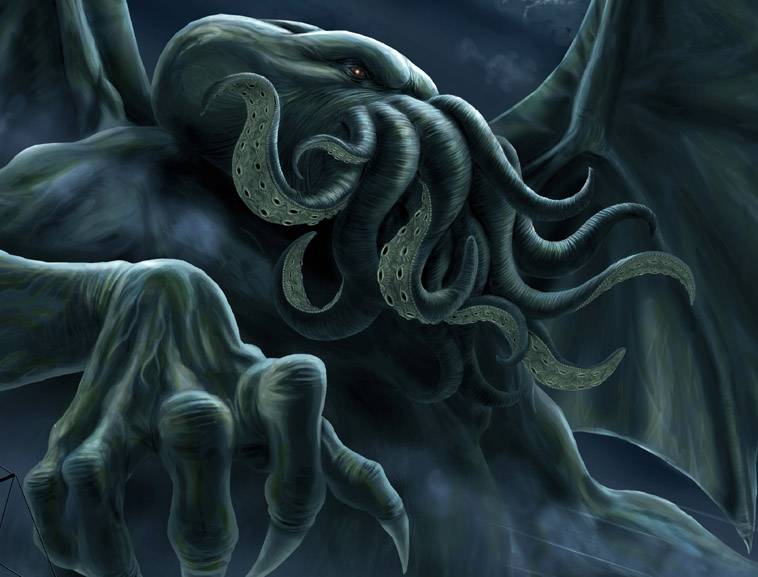
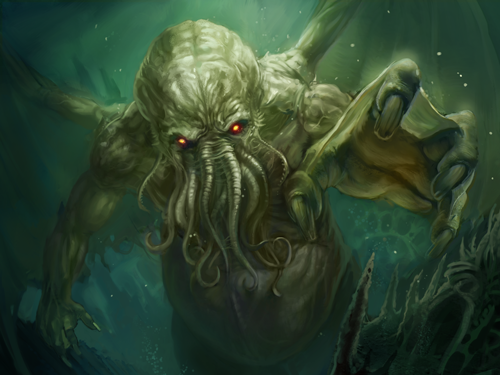
The Call of Cthulhu is broken down into three sections.  The first is written as a journal (as most of Lovecraft's works are) written by one Francis Wayland Thurston.  In seems that his great uncle recently died and has come to inherit the old man's papers and personal effects.  In looking through these items, Thurston finds a sculpture of a hideous monster surrounded by strange symbols.  It seems to have the body of a man, the head of an octopus (tentacles and all), and giant scaly wings and massive claws.  A bit of exploring hints at curious events leading to mass hysteria in certain parts of the globe - people having horrible dreams and deranged thoughts.

The second section is in the form of a journal entry of Thurston's uncle in which he meets a peculiar man who tells a tale of cults performing horrible rituals and giving praise to a creature called Cthulhu, whose description matches that of the sculpture.  They were overheard chanting the phrase "Ph'nglui mglw'nafh Cthulhu R'lyeh wgah'nagl fhtagn." (later translated to "In his house at R'lyeh dead Cthulhu waits dreaming".

In the last segment of the story, Thurston happens upon a transcript of a sailor's journal which describes a landing on a horrible slime covered island.  The monstrosity they discover there could spell the destruction of the would.

An interesting thing to note here is that Lovecraft utilizes a mechanic called plausible deniability.  That is to say that events occur in such a way that only a few people know of them.  In this case, Thurston is the only man alive that knows about the lurking presence of this evil Cthulhu creature.  By keeping the events in his stories a mystery to the outside world, Lovecraft increases the tension that the main character is feeling.  There is no sense of "Oh, Cthulhu, I read about him in the newspaper."  Each character is on his own as far as discovering the hidden truths of the universe.  Lonecraft does this with many of his stories.

Read the full version of The Call of Cthulhu here.