Showing posts with label Spotlight. Show all posts

Friday, September 9, 2011

Spotlight: The War of the Worlds Broadcast of 1938

The year was 1938 - 40 years after H.G. Wells' The War of the Worlds was originally published.  On the evening of October 30th, families tuned into their radio programs just in time to hear of a horrible alien invasion taking place in New Jersey and New York City...  At least that's what many listeners thought.  In reality, what they were listening to was simply a dramatization based on The War of the Worlds.

In the 1930's, CBS had been regularly airing a theatrical radio show called Mercury Theatre on the Air.  One of the masterminds behind this radio show was actor Orson Wells.  Every week, Wells and his company of actors would put on shows for their radio listeners.  On that October evening, Wells decided to put on a show based on The War of the Worlds.  It begins with an introduction taken from the novel, and is presented as a series of news broadcasts in which a Martian invasion occurs in New Jersey.

Many of the families listening to the broadcast, however, were confused and thought that the invasion was actually happening and that they were listening to actual news broadcasts.  This confusion was due to a few different factors.  The first is that Wells' show only mentioned the fact that it was fiction three times throughout the hour-long broadcast:  once at the very beginning, once 40 minutes in, and once at the end.  So anyone that missed the beginning of the show would have had no idea of its true nature.  This was compounded due to the fact that many people missed the first 10-12 minutes of the show because they were listening to another show that was airing concurrently on ABC.  By the time that they changed the dial to CBS, they were lost.

Listen to the entire broadcast!!!

Although many events have not been confirmed, there were supposedly many cases of fear and hysteria on the part of the ignorant listeners.  People could swear that they smelled the poisonous gas that the Martians were spreading across the country.  Some people were terrified to leave their homes, while others swarmed to the site of the supposed Martian landing.  There is also a story that a group of armed individuals shot at a water tower, thinking that it was a Martian tripod.  The New York Times published an article describing the chaos and fallout:


After the night of the radio broadcast, the public became irate.  They believed that Orson Wells intentionally deceived the listeners.  Neither CBS nor Mercury Theater on the Air were officially punished, and the entire fiasco served to propel Orson Wells to fame.

Orson Wells' reaction to the supposed hysteria his show caused...

I hope you enjoyed this look into one of the greatest "hoaxes" in history!

Friday, August 27, 2010

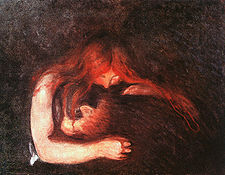
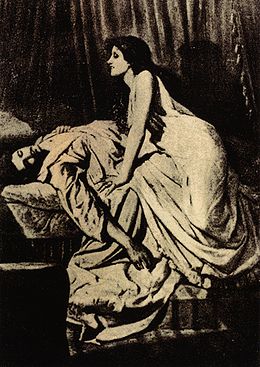
Origins of the Vampire

Greetings to you during this fine week of the Vampire.  I would like to wrap up the week with a brief discussion about the origin of the vampire:  where the myths originated, the beliefs that led to the legends, and the rise of the vampire in popular culture.  There is a ton of information out there, and this post will primarily serve as a summary and a starting point for your own research.  Feel free to check out the links at the bottom of the page for more information.  And without further delay, let us begin our journey...

Although the term "vampire" is a relatively new one, ancient cultures have all had their own way of describing evil entities who survived off of the life and essence of others.  These were classically monsters or demons that fed off of the blood of living people.  The ancient Persians described men who drank the blood of their fellows.  Gods and goddesses of religions were known to drink the blood of their worshipers; both Sekhmet of Egyptian lore and Kali of Indian legend are examples of this.  Even the Old Testament of the bible describes Adam's first wife, Lilith, as giving rise to demons who would drink the blood of men, women, and children.

The first manifestation of what we would now consider a vampire legend occurred in ancient Slavic culture.  Through a mix of pagan worship and the new influence of Christianity, these individuals strongly believed in the separation of the body and the soul, and that if a malignant soul was buried improperly, it would rise again and take the form of an animal or human to destroy its former loved ones.  The evil spirit, called a vampir would be so jealous of life and beauty that it would strip all things of these boons.

As these legends began to spread to Western Europe during the Medieval period, new stories of horror began to spring up.  In a grim preview of the ignorance that would fuel the witch trials of early America, hysteria swept throughout Europe and countless innocent citizens were murdered and maimed in the name of slaying possible vampires. 

The romanticism of the vampire myth began as a result of John Polidori and his short story, The Vampyre, in 1819.  In it, Lord Ruthven is a suave vampire who seduces and kills innocent women.  Vampires popped up in plays and serial publications for the next few decades until Bram Stoker published the quintessential vampire tale, Dracula, in 1897.  This novel has served as a jumping-off point for countless movies, novels, comic books, and television shows.

Despite this period of marketing the vampire, legends and paranoia still abound in some parts of the world.  In the early 2000's, accusations of vampires in Africa led to at least one man being stoned to death.  There have also been urban legends in England that a series of murders occurred in which the victims were bitten on the neck.  In 2004, a Romanian family dug up the corpse of a man and burned it under the assumption that he may become a vampire.  It is clear that the legend still lives on.

I hope you enjoyed this stroll throughout the history of the vampire.  For more information, feel free to follow these other leads:

Wikipedia
The Watcher's Zone
The Mythology of the Vampire

Head on over to The Maiden's Court for Heather's long-awaited review of Dracula in Love, by Karen Essex

And today is your last day to enter the giveaway for Dracula by Bram Stoker!  The winner will be announced tomorrow.

Thursday, August 26, 2010

Know Thy Enemy! Anatomy of a Vampire

Throughout history, many attributes and powers have been attributed to the vampire.  Today, we inspect the anatomy and physiology of a vampire, as put forth by Bram Stoker in Dracula.  One can only hope, dear reader, that this makes you prepared in the event that you face a member of the undead.

The Strengths of a Vampire...
  • Super human strength.  Stoker depicts Dracula has having the raw strength of twenty full grown men.  This enables him to fight proficiently and climb up walls.
  • Transformation.  Dracula is able to transform into different animals, many of which are so called "evil", such as rats, bats, and wolves.
  • In the mists.  Vampires are able to turn into mist and fog, and travel through very small cracks.
  •  Immortality.  The vampire does not die of old age, and cannot be killed with traditional weapons.
The Weaknesses of a Vampire...
  • Distaste for garlic.  The scent of garlic, especially the garlic flower, keeps a vampire at bay.  Wearing a garland of garlic flowers can keep an individual protected, and lining windows and doors can bar an entire room from the undead.
  • Unholy monsters.  Holy symbols, such as holy water and crucifixes, can stun a vampire and make it flee.  A blessed Eucharist can be used to seal doorways or be placed in the vampire's coffin to bar its entry.
  • Limited traveling.  Vampires can only cross running water when the tide changes.
  • Picky sleepers.  A Vampire often sleeps during the hours of daylight, and then only on the soil of their native land (often contained in a box or coffin).  Contrary to popular belief, Dracula is able to come out during the day.  This myth came about in the film, Nosferatu.
Other Traits...
  • Little to no vanity.  Upon looking into a mirror, vampires show no reflection.
  • Sneaky sneakers.  Vampires do not cast a shadow.
  • Polite, too.  Dracula is not able to enter a household unless an individual who resides there gives him express permission.
Disposal of a Vampire...
  • Heartless.  A stake must be driven through the vampire's heart.  Ash or oak is best.  The vampire must then be decapitated and garlic must be placed in its mouth.
I hope you enjoyed this examination of the vampire.  Now, check out The Maiden's Court for the second part of our interview with Karen Essex, author of Dracula in Love.

And remember to enter the giveaway for Dracula.  The giveaway ends tomorrow!

    Tuesday, August 24, 2010

    Vlad the Impaler - the Man Behind the Myth

    Bram Stoker's depiction of the master vampire Dracula has become so iconic that the character has been replicated countless times.  Dracula has become the pinnacle of vampire lore, a mold to which all others are compared.  However, an even more interesting story is centered around the man whom Stoker took inspiration from in his horrific antagonist:  Vlad the Impaler.

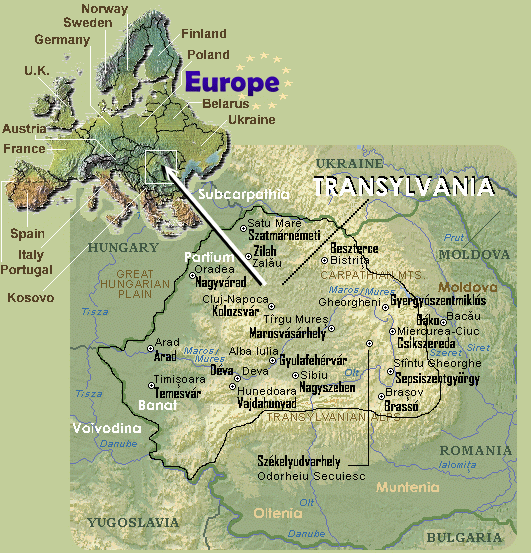
    Vlad III (the Impaler) was born in Transylvania (present day Romania) in 1431, and would be destined to be a ruler, an avenger, and a monster.  In seventeen short years, he would rise to become the ruler of Wallachia, an area within modern day Romania.  The wake of blood and death he left in his path would prove to be more than enough inspiration for Bram Stoker.

    Vlad's story actually begins with the story of his father, Vlad II.  Vlad II adopted the surname of Dracul, meaning dragon, when he was inducted into the Order of the Dragon.  This brotherhood of knights were sworn to protect the Holy Roman Empire and wage war against the Islamic Turks.  Surprisingly, Vlad Dracul betrayed the Empire and made a deal with the Turks - he would give up his two sons (one of which was Vlad III) to the Turkish Sultan in exchange for power and wealth as the ruler of Wallachia.

    Vlad Dracul's life was cut short, however, when his brother (still loyal to the Holy Roman Empire) assassinated the traitor and filled the court with his followers.  Vlad III, taking the name of Dracula, meaning "son of Dracul", was released and eventually rose his own group of rebels to overthrow his uncle.  Dracula forced his uncle's strongest followers into slavery and killed and tortured the rest.

    Although Dracula showed that he was skilled in various forms of torture and murder (burning alive, decapitation, etc), his favorite by far was impaling, in which a human body was impaled on a large vertical pole, the weight of the body slowly pulling it downwards.  The death was painful, and slow.  In this way, Vlad the Impaler struck fear into the hearts of his enemies and followers alike.

    Another example of Dracula's brutality:  When he decided that hunger and poverty held no place in his kingdom, Vlad gathered all of the poor and hungry from the streets and invited them to a large banquet.  When asked if they would like to never feel the pains of hunger again, the pauper's were obviously overjoyed - until Vlad ordered the banquet hall sealed off and burned to the ground.  No one survived.

    After many battles and shifting alliances, Dracula wandered down his father's footsteps one more time when his brother betrayed him.  Vlad's demise finally met up with him when he found himself in the middle of a battle that he could not win.  He was decapitated, and his head was impaled for all to see.

    Now that you have read about the origin of the character of Bram Stoker's Dracula, head over to The Maiden's Court to listen in on a conversation between Heather and I about the similarities and differences of Dracula and Dracula in Love.

    And also don't forget to enter the giveaway of Dracula.  It ends this Friday!

    Sunday, June 13, 2010

    The Chateau d'If: Island Fortress

    "...the sudden appearance of this strange shape, this prison shrouded in such deep terror, this fortress which for three centuries has nourished Marseille with its gloomy legends, had the same effect as the spectacle of the scaffold on a condemned man."
    So describes Alexadre Dumas of the island prison in which protagonist Edmond Dantes is incarcerated in The Count of Monte Cristo.  The novel made the island fortress famous, but behind the legend lies the truth of the "terrible" Chateau d'If.

    Lying on the island of If off the coast of Marseille, France, the Chateau d'If was constructed in 1524 under the rule of Francis I.  Marseille was annexed by Francis and the fortress was erected as a means to "protect" the new province.  However, it is thought that the island fortress served more to discourage any uprisings from the city against its new ruler than to keep it safe from harm.  In truth, the stronghold was poorly constructed and did not see any combat - from foreign shores or otherwise.


    In the late 17th century, the fort was converted to a state prison into which protestants and politicians thrown when the political tide of France flowed against them.  It has since been demilitarized and is now a popular tourist attraction of Southeastern France.

    Note:  Although this video shows signs of the cells of Edmond Dantes and "The Man in the Iron Mask", there is no record of these individuals having been incarcerated in the Chateau.

    And so, in stark contrast to the horror that Dumas pours into Chateau d'If in The Count, the true story is quite benign.  Although one may be disappointed at the lack of spirits haunting the stone walls, it serves as an excellent example of how an author can spark the imagination  of his or her readers.  Stay tuned for more spotlights on the places and people of The Count of Monte Cristo!

    Thursday, February 18, 2010

    Trapped in the Arctic: Captain Crozier and the HMS Terror

    Hi folks. In today's Spotlight post, I'd like to talk about the historical facts upon which my current read (The Terror, by Dan Simmons) is based.
    The Terror tells the tale of what happened to the crew of HMSs Terror and Erebus on their arctic expedition to force the Northwest Passage in 1845-1848. This novel is best described as a work of historical fiction. However, no one knows what became of the failed expedition, so Simmons has plenty of room to play around with the story and what might have happened. Part historical, part science fiction, part horror; The Terror is a unique read.

    The Northwest Passage is the name of an ocean rout through the north Atlantic and waterways of northern Canada. Since the 1500's, explorers jumped at the opportunity to discover a safe way through the Northwest Passage, since it represented a possible trade route between western Europe and eastern Asia. This was no easy task, however, as the Arctic waters of the Passage were plagued with icebergs and often frozen into a solid pack ice that would crush ships if one was not careful. As it happens, the Northwest Passage was not successfully navigated until 1903, some four hundred years after the first attempts. The Terror tells the tale of one ill-fated expedition to force the Passage.

    The British expedition including HMS Terror set sail in 1845. The ship began her life as a bombing ship, first commissioned to fight against the Americans during the War of 1812. Because she was so sturdily constructed, she was a good choice for exploration in sub-zero temperatures. Her hulls were reinforced with the strongest oak available, and she was outfitted with a coal-powered steam engine to both add thrust and to heat the vessel in the cold. Terror first explored the Arctic in 1836 under the command of George Back, when she came in contact with an iceberg and had to be sailed back to Ireland before she sank to the frigid depths of the northern Atlantic. After that, she sailed to Antarctica with HMS Erebus under the command of James Ross and Captain Francis Crozier.

    Francis Rawdon Moira Crozier, born in 1810, joined the Royal Navy at the age of 13 and quickly became a Mate and then Lieutenant. After taking part in two failed attempts at forcing the Northwest Passage on other ships, he found his final berth on Terror.

    In 1845, HMSs Erebus and Terror set sail once more, this time bound for the Arctic Circle and the Northwest Passage. The expedition was last sighted in 1845, entering Baffin Bay. The ships and crew would never leave those frozen waters. After losing contact, the world had no idea what happened to the expedition until a message was recovered from the snow in 1848.

    The ships are trapped in the ice. The crew is abandoning their ships. They are seeking shelter in the ice-coated plains of northern Canada.

    Later: artifacts, graves, and bodies are found in the snow. No one survived.

    What happened to the crew of Terror and Erebus? Why did they leave the shelter of their ships and risk certain death of exposure in the unforgiving Arctic? Dan Simmons tries to answer these questions in his epic novel, The Terror.

    Sunday, December 27, 2009

    Spotlight - The Mythology of Morpheus

    Every so often, I plan to take an item or issue that was raised in a story and research it in order to share a greater understanding of the story as a whole. The first "spotlight" segment features the main character of the Sandman comic book series by Neil Gaiman - Morpheus.


    According to Greek mythology, Hypnos, the god of sleep, had three sons. Their names were Morpheus, Phobetor, and Phantasos. These three sons were the gods of dreams, the most powerful of which was Morpheus. Phobetor was charged with creating frightening dreams. Phatasos was responsible for puzzling and confusing dreams. Morpheus had the ability to change is form into any human being and ruled over the Dream World where he and his brothers resided.

    Although Morpheus was able to change his form at will, he is classically described as a hansome winged being who is one with the shadows. He is also known to appear in the dreams of powerful people as a messenger of the gods.

    Morpheus' Dream World is barred by two gates. One is made of horn and the other is made of ivory. False dreams passed through the gate of ivory while true dreams passed through the gate of horn. Also, the gates of Morpheus' domain were guarded by feirce monsters to keep all intruders out.

    Morpheus was also the master of the onerii, black-winged spirits who were the embodyment of dreams.

    Some fun "facts" about Morpheus:

    - The narcotic drug - morphine - was named after the god of dreams (or shares the same root, at least).
    - Laurence Fishburne's character in The Matrix is named Morpheus, and is responsible for the dream-like transition that Neo makes.
    - Morpheus visited Agamemnon's dreams in Homer's The Iliad.
    - Morpheus is the nephew of Thanatos, god of death.