Saturday, March 24, 2012

My thoughts on The Hunger Games

I admit it, I am late to the Hunger Games party.  I never had much of an aversion to the books.  I would just go into the book store, see them sitting in the young adult section, and proceed onto the Sci Fi/Fantasy section.  I really wanted nothing to do with the YA scene, thank you very much.  The last YA book I read was Harry Potter and the Deathly Hallows, and that was only because I had grown up with the series.

The cover art of The Hunger Games was nifty, but the book didn't draw me in - even when I found out what it was about.  A while back, I had read The Running Man, by Stephen King.  For those of you who don't know, it centers on a televised fight to the death.  I figured The Hunger Games would just be more of the same, except narrated by a twelve year-old, and watered down to be served to a nation of twelve year-olds

I remember there being some generalized hubub when the third book in the series came out, but for the most part I completely forgot about it.  That was, until I saw the movie trailer for the first time.  What?, I thought.  This awesome looking movie is based off of those kids books?.  I continued to ignore the movie and the books - what can I say, I tend to be stubborn.  I finally decided last week that I was going to see the movie.  But, as a general rule, I can't bring myself to see a movie based on a book without reading the book first.  Ugh, now I have to read it.  Heather got me the book on Wednesday, I finished it by Friday, and I went to see the movie the day after.

Needless to say, I was impressed.

As I'm sure everyone knows by now, The Hunger Games takes place in a dystopian future-version of America.  Each of twelve districts are required to send two children to the Capitol as tributes where they will fight to the death.  This event is meant as a way for the Capitol to assert dominance over the districts.  I was pleasantly surprised with how Suzanne Collins integrated these political issues in the novel.  Although perhaps not the most believable, they actually give a reason for the Games to exist.  You can feel the tension in the characters' poor quality of life out in the districts as compared to the lives of excess in the Capitol.  You can hear it in the way certain characters act and talk to each other.  It's palpable as the tributes fight to the death as penance for a crime that was committed before they were born.

What really surprised me, however, was how brutal the book was.  Though The Hunger Games is a YA book, Collins does not take it easy on the violence.  Although some parents will definitely view this as a bad thing (and rightly so in many cases), the violence is required for this book to have any substance at all.  Collins  uses teenagers being forced to kill each other to try to shock you with the injustice of the Capitol, and she definitely succeeds.

It turns out that I liked the movie even better than the book.  Now, that is not to say that the movie was necessarily better than the book.  If I hadn't read the book first, I think I wouldn't have enjoyed the movie nearly as much.  But the movie is beautiful.  It puts into vivid imagery imagery everything Collins describes, and even some things she doesn't.  For the first time, we get to see commentators talk about what is going on in the Games and the events unfold.  We get to see the contestants' mentors working in the background to try to secure sponsorship.  We get to see the leader of the Games argue with the president of the Capitol about how to handle the show.  All of these things make a decent novel into an amazing and entertaining 2.5 hours.

Read the book.  See the movie.  You won't regret it.

Friday, February 3, 2012

Board Game Review - 7 Wonders

Title:  7 Wonders
Publisher:  Repos
# of players:  2-7
Play time:  30 minutes
Age range:  10+

Rating:  6 out of 7 Wonders

Board games have come a long way from Scrabble and Trouble.  There are games based on so many different themes that someone with any kind of taste can find something they enjoy.  I have recently started to enjoy ancient cultures and ancient history, and 7 Wonders fits perfectly!

7 Wonders is a card game for two to seven players.  No matter how many players you chose to play with, the game usually only lasts about 30 minutes.  This makes it a great option for both small and large groups of people.

In 7 Wonders, each player takes on the role of a leader of an ancient civilization.  As such, they strive to build up their cities, make bold advances in science and technology, bolster military might against their neighbors, and construct their magnificent wonder.

Just a few of the available civilizations that players can rule - Olympia, Babylon,
Halicarnassus and Ephesus

The first thing that you will notice about 7 Wonders is the beautiful artwork on the cards.  Each card represents a structure and each structure is vibrantly detailed and colored.  As more and more cards get played, the table that you are playing on starts to bloom with color.  The game is just beautiful to look at, and although that doesn't say anything about the game play, it definitely goes a long way to making you want to play the game.

Speaking of game play, at the heart of 7 Wonders is a mechanic called "card drafting".  Each player is dealt a hand of seven cards, and they each choose one to play.  This card is laid in front of the player and the structure it depicts is considered to be built in their civilization.  Each player then passes the remainder of the hand to the player on their left, and everyone chooses another card from their smaller hands.

An example of a hand in 7 Wonders

The fact that you can only choose one card from each hand means that you need to make some very tough decisions.  Do you take that blood-red military card that will help you defend your city, or do you take that science card to become more technologically advanced?  The cards that you don't choose will be passed to your neighbor, and you may not get another chance to play them.

This mechanic is quite enjoyable, and gives you the feeling that you really need to weigh the pro's and con's of each card.  Each type of card (red military cards, green science cards, blue civilian structures, and purple guild cards) give their own type of benefit, and victory can be attained by using any combination of them.

As the game progresses, players put structures they have built in front of them,
growing their empires

In terms of theme, 7 Wonders is great in some aspects and O.K. in other aspects.  As noted earlier, the artwork on all of the components is beautiful, and this makes playing cards really feel like building the structures that they are meant to represent.  The player boards that represent the civilizations are especially detailed and are a joy to look at.  The one thing that distracts from the theme of the game is the drafting mechanic itself.  Selecting buildings and passing the remains of the hands along may be a great strategic element, but does not necessarily capture the essence of managing an ancient civilization.

All things considered, 7 Wonders is a very enjoyable experience.  The rules are easily understood and the game plays quickly enough to be accessible to all, regardless of your gaming experience.  The components are of excellent quality and the game feels very tight and balanced.

6 out of 7 Wonders!

Sunday, January 22, 2012

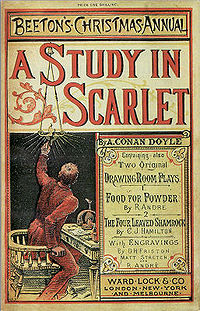
Book Review: A Study in Scarlet, by Arthur Conan Doyle

Title:  A Study in Scarlet
Author:  Arthur Conan Doyle
Genre:  Mystery
Rating:  4 out of 5 magnifying glasses

A Study in Scarlet is the first Sherlock Holmes story written by Sir Arthur Conan Doyle.  I recently acquired the collected Sherlock Holmes stories, and I figured I should start at the beginning.  This is not only my first Holmes story - A Study in Scarlet was the first pure mystery novel I have read.  I always hesitate in reviewing classics such as this, but I plan on reading more of Doyle's work in the future, and documenting how I felt about his first novel seems like it would be helpful.

A Study in Scarlet is written as a first hand account of one Doctor John Watson, a former military man who fought in Afghanistan during the war.  Upon returning to London, he quickly finds he is without a roof over his head!  He discovers that a strange fellow by the name of Holmes is looking for a roomate, and they quickly strike up a partnership.

Soon after Watson discovers that Holmes works as a consulting detective, they are employed in a very sticky case involving a dead man found in a room that is splattered with another man's blood.  One of the only clues: the German word for "Revenge" scrawled on the wall in scarlet blood.

The character of Sherlock Holmes is nothing short of amazing.  He is at once timid and outgoing.  He is a genius when it goes to clues and the violin and completely ignorant of other things - such as the fact that the Earth revolves around the sun.  Holmes is truly eccentric and I love him all the more for his short-comings in all areas other than his profession.  Watson, on the other hand, is a little less vivid.  We get a bit of back story on him at the beginning of the story, but he is often relegated as the "straight man" as played against Holmes' genius.  His most common lines seem to be on the theme of either "But wait, I don't understand your logic" or "Truly you are brilliant Holmes!".  I kept yearning for more of a relationship to form between the characters, but it never quite got there.  Of course, this is only the first in a series of many stories, so I'm sure there is still ample opportunity for Watson to emerge from his sidekick cocoon and grow into a deeper character.

The mystery itself (don't worry, no spoilers here) was well done.  Clues were presented at a regular pace, and you just knew that Holmes was piecing them together even before you realized their importance.  There were multiple suspects and you definitely won't see the end come until Holmes has the perpetrator in shackles.

There was one thing that took away from the quality of the story.  About half way through, after Holmes apprehends the murderer, the entire narrative completely changes.  Instead of first person from the point of view of Dr. Watson, the narrative turns into third person omniscient.  This is done to detail the history of the murderer, his motives, etc, but the transition is so jarring that it almost made me want to stop reading.  The witty observations of Watson were gone, and in their place, col, impersonal descriptions of a completely different country in a completely different time.  Luckily, I was able to get through this and Watson's account quickly resumed.

A Study in Scarlet was a fun little story to read.  Its genius comes from the fact that it is so succinct and compact, while still managing to illustrate a convincing protagonist and compelling plot.  If you have any interest in starting to read about Holmes, you should start here and enjoy, as I did!

4 out of 5 magnifying glasses!

Thursday, January 19, 2012

Card Game Review - Fluxx

Title:  Fluxx
Publisher:  Looney Labs


# of players:  2-6
Time:  15 minutes
Age Range:  8+


Rating:  3 out of 5

The rules of Fluxx are simple:  Draw one card, play one card.  You play cards to try to meet the current goal...  But... then someone can change the goal.  And then they make it so you can draw three instead of one, play two cards instead of one, and shuffle up all of the cards on the board and deal them out randomly!  The goal changes again and the discard pile is shuffled back into the deck.  How will you win now?

As the box states, Fluxx is a game of ever-changing rules.  If you're going to win, you will need to keep up!

That intro may have made this game seem complicated, but you really shouldn't be too intimidated.  At its heart, Fluxx is very simple and is more about altering current rules than adding completely new ones.  There are four different kinds of cards...

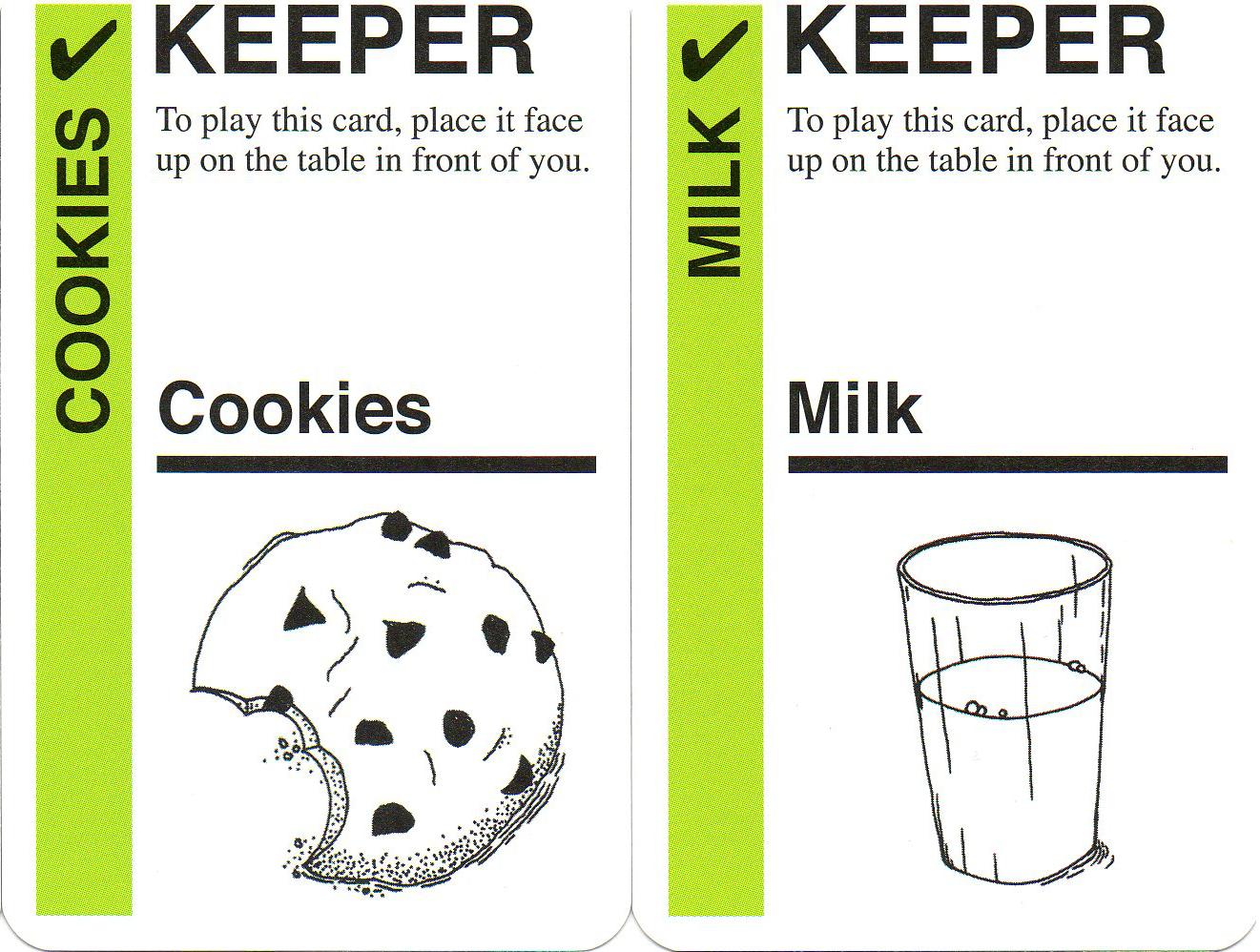
Keepers:  These cards represent things or ideas.  You play them from your hand and you try to make a collection that meets the current goal.  If you meet the current goal, you win the game!  This include Milk, Cookies, Time, Death, the Sun, Love, Money, and so many more!

Goals:  These cards tell you which keepers you need to have in front of you to win.  These goals combine keepers in ingenious ways such as "Time is Money" (you win if you have Time and Money on the table) and "Hippyism" (you win if you have Love and Peace on the table).

Actions:  These cards are used to do a ton of different things including drawing extra cards and stealing keepers.  These are really powerful - use them wisely!

New Rules:  These cards are placed in front of you and alter many different rules of the game.

So that is how you play... but what does it FEEL like to play?  Well, Fluxx is a lot of fun!  The game is easy to learn and each round plays very quickly.  The goals make you really think about which keepers you want to play, and there is some degree of strategy in the order of the cards you play.

The thing that really draws this game down, however, is that all it takes to win is a bit of luck.  At its heart, Fluxx is just a card-drawing game, and that means that play can get very random.  No matter how much strategy you try to put into the game, your carefully laid plans are always vulnerable to a lucky draw on the part of one of your opponents.  But in the end, Fluxx isn't supposed to be a serious strategy game.  So you lost that round to a lucky draw - so what?  Just shuffle up and play again?  Odds are, you will get completely different cards and will win through a completely different route.

Fluxx is a perfect game to pull out and play if you only have a few minutes to spare, or if you want a light enjoyable experience with which to pass the time.  What it lacks in depth is made up for in charm.


3.5 out of 5.

Tuesday, January 17, 2012

Television Review - Alcatraz Pilot

Title:  Alcatraz
Creators:  Elizabeth SarnoffSteven LilienBryan Wynbrandt
Producer:  J.J. Abrams


Genre:  Drama / Science Fiction
Rating:  4 out of 5 cells

Let me first say that I am a big fan of J.J. Abrams.  I had a lot of fun with Alias, Fringe and LOST, and I loved Cloverfield, Star Trek, and Super 8.  Imagine my excitement when I heard that the man was producing another television show to soak up another free hour of my life every week.  Yes, the pilot of Alcatraz premiered this past week, and I was watching.  What follows is a quick summary of the episode and main characters, and my thoughts on it.

In Alcatraz, three unlikely allies team up to investigate a series of murders committed by people who shouldn't even be alive.  In the 1960's, 302 prisoners were said to have been transferred from the island prison.  We quickly learn, however, that these inmates in fact simply vanished out of thin air.  Fast-forward to present day:  these same criminals are showing up in San Francisco with a debt to settle.  What is even more strange, however, is that they haven't aged one day.

Our journey begins with Rebecca Madsen (played by Sarah Jones), a San Francisco Police Officer, as she gets called in to investigate a murder.  We learn (through a convenient LOST-esque flashback) that she witnessed her partner's death at the hands of an as-yet unidentified criminal, and we assume that she wants to be the best cop ever to make up for not being able to save him.  She is quickly shoo'd off the scene by Emerson Hauser (Sam Neil), a tight-lipped know-it-all federal agent.

Leaving the scene with nothing but a stray fingerprint to guide her, Rebecca discovers that the evidence points to one Jack Sylvane, a man who was imprisoned on Alcatraz four decades prior.  She meets up with Diego Soto (Jorge Garcia), a Double PhD/Alcatraz Book Author/Comic Book Salesman (no, I'm not making this up) to investigate The Rock further.  Through a series of unfortunate events, Madsen, Hauser, and Soto (a.k.a. "Doc") decide to work together to find and incarcerate (again) Sylvane.

(end of ridiculous exposition)

As you can see, a ton happened in the Pilot.  Questions were answered and new questions were raised.  But how does it stack up to Abrams' other shows, and is it even worth watching?

The first thing people usually want to know about an Abrams show is how "cliffhangery" it is.  As much as I loved LOST, it would get so frustrating because there were so many plot lines and questions that were never really answered.  Each episode would just make you feel more... well... LOST.  Fringe started to get away from this, but still required a lot of patience to watch.  From what I hear, Alcatraz will try to focus even more on the "one episode, one story" formula.  They will be investigating one case and catching one criminal during each episode.  This sounds a lot like a cookie cutter cop drama (I'm looking at you, CSI and friends), but watching the pilot gives you a feel that there will still be some twists and turns for those devoted to the series.

First of all, Alcatraz employs liberal use of the flashback, something that payed off big for LOST.  Between each commercial break, we are treated to the present-day exploits of our three heroes as they try to catch the villain as well as a look into what this villain's life was like while imprisoned on the rock.  These flashbacks to the criminal's past gives you a lot of insight on the character and renders him more memorable than those goofy bad guys you see at the end of Scooby Doo (or CSI).  It reminds me of Criminal Minds, and the extra effort is appreciated.

Another thing that makes Alcatraz stand out from the pack is that there is obviously something supernatural going on here.  People don't just disappear for 40 years and then pop back up again to commit crimes and run 40K's.  Through a combination of flashbacks and present-day character development, I am sure this story arc will add a lot more energy to the "catch one bad guy a week" formula.  The question is this:  How bogged down will the series get because of it?  (Spoiler:  Only time will tell.)

In terms of characters, we get about as much as we expect from Abrams.  We stick to the formula that worked for Fringe (strong blonde female protagonist, older male superior who keeps information from said protagonist, crazy civilian who really has no business investigating murders) and really don't make any deep changes.  This isn't necessarily a bad thing, however because it could all change when we learn more about the characters.  I, of course, immediately love Emerson Hauser because everything Sam Neil does is genius.  And Hurley Soto isn't bad either.

Finally, the show is visually beautiful.  The past and present time periods are immediately recognizable.  Past-Alcatraz is dark and gloomy, while the prison that Hauser puts the criminals in during the present (which looks structurally similar to the interior of Alcatraz) is bright and sterile.  Even Soto's comic book shop has a bit of a charm to it.

Though eerily reminiscent of Abrams' past projects, Alcatraz seems to be a perfect mix between cop drama and supernatural thriller.  Time will tell how popular the series is, but I plan on watching regularly.


4 out of 5 cells!

--

I hope that you enjoyed this review, and if you are watching the show as well, I would love to know what you think!  I don't plan on writing a review for every episode, but I may do an end-of-season and beginning-of-season summary when applicable.


Monday, January 16, 2012

Lions and Men is Branching Out!

Hello everyone!  As you may have noticed, I haven't posted in a while.  What can I say, school has started up again.  And although I wish it was not the case, I just don't have as much time to read and post as much as I would like.

With this in mind, I plan on taking this blog in a couple of different directions.  Don't worry!  I will still be reading and reviewing science fiction, fantasy, and horror novels (albeit at a reduced pace).  In order to provide you with more content, however, I plan on also reviewing and giving my thoughts on other fun and geeky things, namely board games, card games, and movies.  Luckily, my taste in games and movies aligns closely with my taste in books, so you can still look forward to the same genres that Lions and Men tends to focus on.

I think reviews of more varied forms of media will be a lot of fun to write, and I hope they will be fun to read. You can look forward to some new content along these lines in the coming days!

Friday, October 21, 2011

Giveaway Results: Dracula in Love, by Karen Essex

And the winner of the Dracula in Love giveaway is...

Kristy Nicole!

Congratulations!  And than you everyone for participating.

Wednesday, October 12, 2011

Book Review: The Island of Doctor Moreau, by H. G. Wells

Title:  The Island of Doctor Moreau
Author:  H. G. Wells
Genre:  Science Fiction
Rating: 3.75 out of 5

The Island of Doctor Moreau is truly a multi-genre tale.  It combines elements of Science Fiction and Horror.  It also acts as an allegory, mirroring aspects of society.  Beneath it all is one of Wells' favorite themes:  the horrible things that can come about by reckless meddling in science that should be left alone.

The Island of Doctor Moreau is written in the form of a journal of one Edward Prendick.  Through a series of unfortunate events, Prendick befriends some malcontents on a small merchant vessel and debarks to a mysterious island inhabited by horrible beasts.

These beasts are half animal and half human, and Prendick is immediately thrown into a struggle for his life as he fights against the master of the beasts, Doctor Moreau.  Throughout the novel, as the line between civility and savagery is blurred, Prendick is forced to rethink his preconceptions about good and evil, right and wrong.

This book was very fun to read, and really made me think about the undertones and themes that hide under the surface of the pages.  Doctor Moreau was written less than forty years after Darwin's On the Origins of Species.  Throughout the novel, Wells examines the qualities that separate humans from animals, and eventually comes to the conclusion that we may not be as different as the experts think.  Wells suggests that human and bestial qualities rest under the surface of all life, and only the shell of our flesh separates the species.  Moreau shows Prendick that it is quite easy to turn beasts into men, and we come to learn that it is even easier for men to act like vicious beasts.

The major problem that I have with this book is that it is so improbable.  Yes, I realize that I walk a thin line when I say things like that in reviews, as I write a blog abut fantasy and science fiction.  However, to me, a work of science fiction only works when the science feels like fact.  Wells asks us to believe that turning a beast into a man is as easy as plastic surgery, but this reader remains unconvinced.  The entire premise makes the book feel more like a long metaphor than an actual science fiction novel that one expects when thinking of the author's other works.

In the end, I really enjoyed The Island of Doctor Moreau.  Aside from a few preachy segments in which Wells' message comes through too clear, the novel was a fun ride through a haunted house of grotesque beasts and even more nefarious men.

3.75 out of 5 man bear pigs.

This review is a part of Dueling Monsters 2011

Thursday, October 6, 2011

Excerpt and Giveaway - Dracula in Love, by Karen Essex

Today, I would like to share an excerpt from Dracula in Love, a Victorian horror romance, written by Karen Essex.  You might remember this one from when I interviewed Essex during Dracula Week.

At this point in the novel, Mina Harker wakes find herself in an insane asylum while Doctors Seward and Van Helsinger prepare to perform experiments on her...

"I was in a somnolent state, in which the line between reality and hallucination was easily blurred, my mind alternating between the sweet sensations of my imagination and the faint sounds in the room – the tinkling glass and metal as Seward and Von Helsinger prepared for the procedure, words muttered between them in German, and the low, ambient hum of the asylum’s inmates.

All of a sudden, I felt a shift in the room, as if someone had made a surprise entrance, but through hazy eyes, I saw that the door was still closed. Von Helsinger’s alarmed voice barked exclamatory words to Seward in German, and Seward responded with a strange cry. I wanted to slip back into my reverie, but then something crashed to the floor, as if one of the doctors had dropped a thing made of glass. I opened my eyes again and in my dreamy state, I thought I saw a thick mist seeping through the shuttered window. Confused, wondering if this was part of a dream, I blinked my eyes and looked again. The two doctors – eyes wide with astonishment – stood frozen, watching the vapor as it swirled before them, growing in luminescence and intensity. Before our eyes, the numinous particles began to sculp into a form, and I thought that perhaps an angel ad come to save me.

Slowly the thing took shape. It was not an angel but a shimmering coat of silver fur, which gradually molded itself over great muscled haunches, its outer ends elongating into a bestial tail and head. My dream world collided with my reality as I watched the wolf dog I had seen in Whitby growl at Von Helsinger, backing him against a wall and baring his teeth at the incredulous doctor. Von Helsinger pressed himself against the wall, yelling something in German, and the beast lunged at him, pinning him with its thick paws. The treacherous canines were not an inch from Von Helsinger’s face. Seward tried to get the door, but the wolf dog turned around and, with preternatural speed, leapt on him from behind, sinking its teeth into the doctor’s back. Seward cried out in anguish as he pulled away, leaving some of his flesh in the animal’s mouth. Von Helsinger pushed Seward through the door, but before he could escape, the animal swiped at his face and neck, leaving sharp claw marks from check to throat. With a howl of agony, Von Helsinger grabbed his face and fell through the door after Seward, slamming it shut. I lay in bed paralyzed. The wolf dog jumped on the bed, straddling me, staring at me with its vivid indigo eyes. The last thing I remember seeing in that room was his huge incisors above my face, red and dripping with Seward’s blood." (pp 254-255 of the ARC)

Also, I am excited to tell you that the publisher, Doubleday, has offered a brand new paperback copy of the novel for Lions and Men to give away!  So here's the deal!

The giveaway will run from 10/06/2011 to 10/20/2011.  The winner will be drawn at random and will be announced on 10/21/2011.  US and Canada entrants only.  To enter and increase your chances of winning...

+1 entry:  Comment on this post and include your email address (required to enter)
+3 entries:  Become a follower, or tell me if you are a follower
+3 entries each:  Start following me on Twitter or on Goodreads, or tell me if you already do
+1 entry each:  Link to this post in a tweet, blog post, blog sidebar, Facebook, etc.  Be sure to include a link to your content in your comment.

Good luck everyone!

Sunday, October 2, 2011

Book Review: The Call of Cthulhu, by H. P. Lovecraft

Title:  The Call of Cthulhu
Author:  H. P. Lovecraft
Genre:  Horror
Rating: 4 out of 5

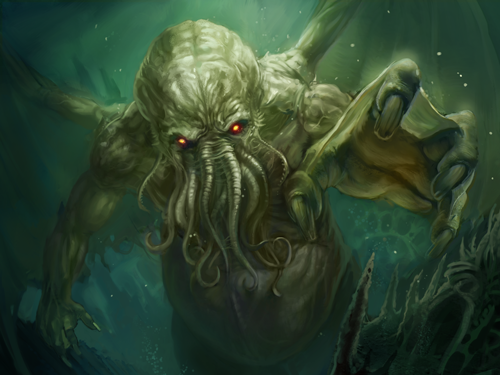
The Call of Cthulhu is one of H. P. Lovecraft's most popular works.  It features his most iconic creature of horror, and is the cornerstone of his entire mythos.  Let's uncover the terrifying madness contained within...

Cthulhu is written in the form of an old journal of a man named Francis Thurston.  After his great uncle's death, Francis discovers that he has come to inherit a body of work that attempts to piece together mysteries surrounding mass hysteria and violent cults.  Together with this information and his own investigation, Thurston describes the unspeakable horror that he uncovers.

The story is broken up into three parts.  Part One, The Horror In Clay, relates how Thurston's uncle investigates a period of a few weeks in which people began having horrific dreams of a slime-covered city rising out of the ocean.  Part Two, The Tale Of Inspector Lagrasse, is a second-hand tale of a police inspector's raid of a cult in the swamps around New Orleans.  The cultists worship a creature similar to the one seen by the troubled dreamers.  Part Three, The Madness From The Sea, is an interview with the widow of a man driven insane by what he saw while sailing on the ocean.

The Call of Cthulhu, like many other stories written by H. P. Lovecraft, works on the basis of plausible deniability. The story is told in such a way that the events that occur go unnoticed by the world.  A single character - in this case, Francis Thurston - stumbles upon cosmic mysteries of the universe before fading into obscurity.  The facts that might destroy the world if they got out are simply re-buried.  The world spins and humanity lives on unaware of the horrors that lurk under the surface.

That is what is so tragic about The Call of Cthulhu.  We, as the reader, are treated to the darkness within the world and then watch it slip through the cracks of common knowledge.  This dynamic adds ample tension to the story.  As Thurston stumbles upon each piece of the puzzle, it is both exciting and heartbreaking.

As a standalone tale, it is difficult to give this story an outstanding rating.  The characters aren't the most vivid, and not much happens until the very end of it.  However, I believe that the value of Lovecraft's work is much greater than the sum of its parts.  When considered as part of the whole, The Call of Cthulhu truly shines.  If you have any interest in Lovecraft, you would not be remiss to start here!

4 out of 5 tentacles!

This review is a part of Dueling Monsters 2011

Tuesday, September 27, 2011

Giveaway Results: Abraham Lincoln: Vampire Hunter

Thank you everyone for entering this giveaway!  The winner is....

Audra!  Congratulations!

Saturday, September 24, 2011

Odd Passenger: An Odd Thomas Story

Odd Thomas, a novel written by Dead Koontz, was one of my favorite paranormal novels when I was younger. It tells the story of Odd (yes, that is his real name), a simple short order cook at a local diner that can also talk to dead people.  In so doing, he tries to bring them peace and prevent future violent acts.  In stead of simply posting a review, I wanted to share with you some video of a story that is based on the character of Odd Thomas.  I feel the following four episodes are a great representation of Odd Thomas, and should give you a good idea of the feel of the novel.


Odd Thomas is also being made into a full-length movie, due out in 2012!

Friday, September 23, 2011

Book Review: Deadline, by Mira Grant *SPOILERS OF FEED*

Title:  Deadline
Author:  Mira Grant
Genre:  Horror
Rating:  4 out of 5

[WARNING][WARNING][WARNING]
This review contains spoilers of the first book in this series, Feed.  This review does NOT contain spoilers for Deadline.  I'm sorry folks, I know I said that I would not include spoilers in my reviews, but it is unavoidable in this case.  All of my feelings for the second book branch off of large events in the first book, and I would be unable to write a complete review if I did not refer to them directly.  If you have not yet read Feed, check out my spoiler-free review here.  If you want a spoiler-free review of Deadline, check out this review on Goodreads.  But, if you have read Feed or do not care about spoilers, click on "read more" below to continue!
[WARNING][WARNING][WARNING]

Monday, September 19, 2011

Book Review: The Strain, by Guillermo Del Toro and Chuck Hogan

Title:  The Strain
Authors:  Guillermo Del Toro and Chuck Hogan
Genre:  Horror
Rating:  4.5 out of 5

It's not every day that two well known names team up to write a novel.  Even more rare is to find a novel about vampires these days that is truly in the horror genre.  How does the first book of their trilogy measure up to this horror reader's expectations?

The Strain follows Dr. Ephraim Goodweather, an investigator for the CDC, as he tries to make sense of a devastatingly lethal outbreak surfacing in New York City.  It all begins when an airliner lands at the airport with all of its lights off, the shades all pulled down, and everyone on board dead.  Eph quickly learns that these individuals aren't deceased, but infected with a pathogen that turns them into blood sucking monsters.  Each night, the contagion spreads throughout the city.  Together with his CDC partner, a city exterminator, and a mysterious old pawn broker, Eph finds that they are on their own against a city full of vampires and a government conspiracy.

The Strain is an impressive mix of classical horror and science fiction.  The vampires are created by the introduction of a pathogen into an human's blood stream when they are attacked by one of the undead.  Because of this, and because the main characters work for the Centers for Disease Control, much of the book takes on a "cop drama" feel as they try to sort out the ultimate cause of the disease and how it is spread.  Sprinkled throughout are descriptions of the vampires feeding, which are truly horrific.

The strongest point of this book is the character development.  Two of the major characters have large back stories that really makes you root for them.  Eph is fighting to keep his son safe and the elderly Setrakian is trying to avenge the people he lost decades ago.  Even the victims of the vampires are all unique and colorfully depicted, something I didn't expect and was pleasantly surprised by.

I also loved the subtle nods to classic vampire lore that Del Toro and Hogan weave into their novel.  Many age-old myths (aversion to sunlight, inability to cross water, no reflection in a mirror, etc) are either incorporated or debunked as old wives tales.  Even the novel's opening scene, where a plane lands with everyone on board dead, is adapted from a scene in Bram Stoker's Dracula.  I'm happy that the authors recognized where their novel came from, and acknowledged its influences.


One thing that I wasn't exactly happy about was the depiction of the vampires.  I know that the authors wanted to get as far away from the "suave, romantic" vampires that plague literature lately, but I think they went too far.  The vampires are autonomous, shambling monsters that think of nothing other than spreading their disease.  Throughout most of the novel I felt like I was reading a book about zombies.  And although that isn't a bad thing in and of itself ("are vampires really that different from zombies?" you ask me incredulously), I think there is something much more scary about an enemy who is craft and intelligent.  For the most part, these vampires are just target practice for anyone with a silver sword or UV light.

With that being said, The Strain definitely lives up to the hype, and makes me look forward to the rest of the trilogy.

Saturday, September 17, 2011

Lions and Men will be participating in Dueling Monsters 2011!


I just wanted to let everyone know that I will be participating in the Dueling Monsters event, which is hosted by Heather J. at Age 30+ Books and Jill at Fizzy Thoughts.

What is Dueling Monsters?  H. P. Lovecraft's Call of Cthulhu and H. G. Wells' The Island of Doctor Moreau are the two featured stories.  Any blogger can review one or both of the stories, and submit their links to Heather and Jill.  They will then post links to all of the reviews.

What does this mean to you?  First, you will get to read my reviews of The Island and Cthulhu before the end of October.  Second, you can go check out the host blogs on October 31st to check out EVERYONE's reviews!


Feel free to join, the more the merrier!

Wednesday, September 14, 2011

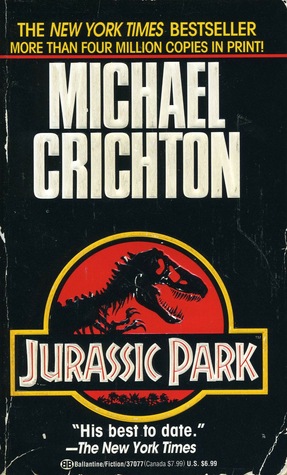
Book Review: Jurassic Park, by Michael Chrichton

Title:  Jurassic Park
Author:  Michael Crichton
Genre:  Science Fiction
Rating:  4 out of 5 velociraptors

Science can do some pretty crazy things.  When a man attempts to bring dinosaurs back from extinction, he risks the lives of everyone in the world. Jurassic Park is a modern classic of science fiction, mostly because of the success of the movie.  But what about the book that spawned that titanic beast of 90's pop culture?

Jurassic Park is a story about two paleontologists that are roped into taking a tour of a yet-to-be opened zoo that features dinosaurs as its main attraction.  Everything goes awry, however, when a greedy computer programmer sabotages the computer system in an attempt to get rich.  With the security fences down, the animals run loose and, well, I don't need to tell you much more than that.

Similar to The Princess Bride, I grew up watching Jurassic Park.  Over.  And over.  And over again.  After reading other works by Crichton, I decided to read the book.  I was nervous that it wouldn't live up to my expectations, but I was pleasantly surprised.

The book is different from the movie in a thousand little ways, most of which are so minor that I don't even remember them a few weeks after finishing the novel.  Some of the ones that stand out are...
  • There is no romantic tension between Alan Grant and Ellie Sattler.  In the movie, there was always something unspoken about the two scientists' relationship.  In the book, this tension is nowhere to be seen.  Ellie is also about 20 years younger than Alan in the book.  I have to admit, I missed this in the book.
  • The book includes many scenes that were not in the movie.  These include Grant and the kids hiding behind a waterfall from the T-Rex and getting lost in a Pterodactyl cage.  I imagine the reason for the scenes being left out of the movie has to do with the technological limitations in 1993.  What is interesting is that analogs of both of these scenes wound up in subsequent sequels to the movie.
Apart from these differences, one notices that the novel goes much further into the science behind the park than the movie does.  Crichton goes to great lengths to try to make his tale believable.  Sure the science isn't really accurate, but hey!  We're talking about dinosaurs here.  The fact that the author tries is good enough for me, and I find it very interesting.  The flip side of this coin happens when Crichton goes to great lengths to describe computers.  Now keep in mind, Jurassic Park was written in 1990.  Back then, computers were a BIG DEAL.  Crichton takes time describing the appearance of computer consoles and the intricacies of DOS-like menus.  Exciting, right?  Maybe in 1990, but not nowadays.  But in some ways, that just adds to the charm of the novel.

A great part of the book is the development of the characters.  And although I had the image Sam Neill stuck in my head whenever I read chapters about Alan Grant, I was able to appreciate the character in a completely new and better way.  Many of the characters have very complicated back stories and emotions.  That alone is a good enough reason to pick up this book.


I had a great time reading Jurassic Park. it was half blast from the past and half brand new experience.

4 out of 5 velociraptors!

Sunday, September 11, 2011

GIVEAWAY: Abraham Lincoln: Vampire Hunter, by Seth Grahame-Smith

Hello friends!  After a long hiatus from blogging, I wanted to thank all of you for sticking with me.  And what better way than with a snazzy new giveaway?

From the back cover...

"While Abraham Lincoln is widely lauded for saving a Union and freeing millions of slaves, his valiant fight against the forces of the undead has remained in the shadows for hundreds of years. That is, until Seth Grahame-Smith stumbled upon The Secret Journal of Abraham Lincoln, and became the first living person to lay eyes on it in more than 140 years.


Using the journal as his guide and writing in the grand biographical style of Doris Kearns Goodwin and David McCullough, Seth has reconstructed the true life story of our greatest president for the first time-all while revealing the hidden history behind the Civil War and uncovering the role vampires played in the birth, growth, and near-death of our nation."

Also, check out my review of the book here.

This giveaway is for one hardcover copy of Abraham Lincoln: Vampire Hunter, written by Seth Grahame-Smith.  The giveaway will run from 09/11/2011 to 09/26/2011.  Please, United States entrants only.  The following is a list of how you can enter the giveaway and increase your chances of winning:

+1 entry:  Comment on this post and include your email address (required to enter)
+3 entries:  Become a follower, or tell me if you are a follower
+3 entries each:  Start following me on Twitter or on Goodreads, or tell me if you already do
+1 entry each:  Link to this post in a tweet, blog post, blog sidebar, Facebook, etc.  Be sure to include a link to your content in your comment.

Good luck everyone!

First Impressions and Book Trailer: The Strain, by Del Toro and Hogan

In a world where romantic and suave vampires are the norm, it is quite refreshing (from a horror blogger's point of view anyway) to come across a book that features terrifying and ruthless undead.  Guillermo Del Toro and Chuck Hogan promise to deliver that with their novel The Strain.  

A mix between CSI and Dracula, The Strain is shaping up to be a great read.  It has mystery, a compelling protagonist, and a slew of horrible blood thirsty monsters marauding New York City.  Expect a review soon, and until then, watch these great videos, including two book trailers!

A word of caution:  Some of the movies have a bit of strong language.


Saturday, September 10, 2011

Movie Reviews: The War of the Worlds (1953 and 2005)

We have already looked at The War of the Worlds novel and the radio broadcast.  Today, I'd like to share with you two movies based on the novel.  One was made in 1953 and the other was made in 2005.  Both of these movies were loosely based on the novel in that they take the events that occur in the novel but follow different characters during those events.  Also, they events take place in different areas.

Title:  The War of the Worlds
Year:  1953
Director:  Byron Haskin
Genre:  Science Fiction
Rating:  3 out of 5 heat rays

This was the first film adaptation of H.G. Wells' novel.  Dr. Clayton Forrester befriends Sylvia Van Buren at the site of the first Martian landing, and we follow them during the assault on the Earth.

This movie feels a lot different from the novel.  The novel focused more on the individual during the alien invasion.  However, Dr. Forrester spends a lot of time talking to government officials and generals in the field.  This gives the movie a much heavier feel.

There are a few parts of the book that I wish the movie incorporated.  The first has to do with the Martians using human blood as food.  This fact paints them in a much more terrifying light.  There is something much more foreboding about humanity being captured and held prisoner as a food source compared to simply being destroyed.  The second point that I missed was the focus on the hysteria that the citizens of the world feel when the planet is invaded.  The only time the movie mentions this is in a small montage, which is disappointing since it was a big part of the novel.

Finally, I need to talk about the special effects.  I'm sure they looked amazing back in the 50's, and there is nothing wrong with old school scifi.  However, the limitations of technology unfortunately altered points of the story.  For instance, instead of large tripods, the aliens ride around in what look like spaceships.  I imagine this is because moving legs would have been to hard to animate.

In all, The War of the Worlds may not be the best movie, but it definitely has a certain charm about it.  Check out the trailer!


---

Year:  2005
Director:  Steven Spielberg
Genre:  Science Fiction
Rating:  4 out of 5 lightning bolts

In 2005, another film was made based on H.G. Wells' classic.  Dock worker Ray Ferrier struggles to protect his two children as the aliens invade New York.

Spielberg took many more liberties with the story than the 1953 movie did.  First of all, the term "Martian" is never mentioned in the movie, and in fact Spielberg said that his aliens didn't even come from Mars.  Instead, they come from a place much more far away and malevolent.

Also, instead of the aliens crash landing on our planet because of the fact that the habitat on their planet was inconducive to life (as in the book), we quickly learn that the tripods were buried under the Earth - possibly millions of years ago.  This makes the motives of the aliens feel much more sinister.  Instead of fighting to survive in a new environment, they are taking back what they believed to be theirs all along using as much force as necessary.

One of the things that I loved most about the movie is the focus on the individuals and the mass hysteria that the invasion caused.  Instead of a famous scientists being the main protagonist (as in the 1953 version), we follow the journey of a middle class guy and his two kids.  They are forced to fight for their lives against the aliens and the humans.  And yes, the threat from their fellow man is just as real as the extraterrestrials.  What would happen if someone had the only working car in the country?  Or if there was only so much space on a ferry that was leaving an alien infested area?  When people's lives are threatened, there is no telling what they will do.

If you are a fan of Wells' novel, then I think you will enjoy this movie.  It is similar enough to appease die-hard fans, and fresh enough to feel new and exciting.  Check out the preview!