Showing posts with label HP Lovecraft. Show all posts

Friday, September 24, 2010

Fun with Cthulhu (the many humourous things people have done with the greatest evil in the known universe)

Happy Friday everyone!  We have come to the end of H. P. Lovecraft week, and I would like to leave you all with a smile.  With the advent of the internet and "geek culture", Lovecraft's Cthulhu Mythos has recently become something of an inside joke to many e-geeks (such as myself).  Although Lovecraft describes Cthulhu as the most evil entity in the universe - and perhaps in spite of that - people love to laugh at the tentacled monster.  I showed you one example yesterday in the form of a humorous story written by Neil Gaiman.  Something about Cthulhu just makes people want to laugh.  Here are a few more examples that you can find floating around on the internet...

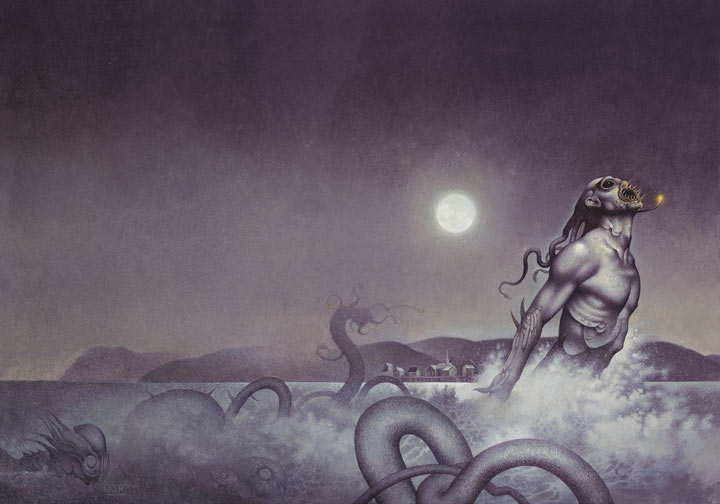
Under the ocean, Cthulhu rests... patiently awaiting the time when he can devour your feet!  er, soul!


Feeling patriotic?  Cthulhu loves the taste of patriotism!


I love the facial expressions on this little guy's victims.  I'd be scared too!


A Cthulhu-based parody of "Hey There Delilah" by the Plain White T's, and a photo montage.

Yes, this place actually exists, and I want to go there.


Foiled again!


Calls For Cthulhu - The Great Old One answers all of your burning questions!


A cartoon about the adventures of Lil' Cthulhu.  Aww isn't he cute?

I hope you all enjoyed H. P. Lovecraft week!

Wednesday, September 22, 2010

The Shadow Over Innsmouth

The Shadow Over Innsmouth is one of my favorite Lovecraft stories.  It focuses on a young man who travels to a run-down Massachusetts port town called Innsmouth for its reputation of picturesque architecture.  He begins to realize, however, that there is a reason that people stay away from Innsmouth.


Robert Olmstead, on a mission to discover the identity of his distant ancestors, finds himself in rural Massachusetts.  On the tips of some of the people he meets, he decides to take a bus into Innsmouth.  The people he meets on the bus, and later in town, seem to look a little strange.  They have sloping foreheads, big lips, and bulging fishy eyes.  Once in town, he asks around and eventually hears rumors about the interbreeding of the citizens of Innsmouth with fish-like creatures that came from the sea.  This story shakes Olmstead's nerves, but he eventually chalks it up to unfounded rumors and speculation.

That is, until, the bus he hoped to take out of town before night fall breaks down, leaving his stranded in Innsmouth.  Olmstead is forced to sleep overnight in a run down hotel when the natives suddenly become hostile.  Olmstead must choose to either flee or run for his life but one this is sure - what he discovers off the shores of this little Massachusetts town will alter his life forever.

The Shadow Over Innsmouth is unique from Lovecraft's other works in that it partially abandons the theme of plausible deniability.  By the end of the story, a police investigation begins regarding the people of Innsmouth.  However, we don't know the result of the investigation...

I loved Innsmouth for two reasons.  One is the great "chase-scene" that ensues, in which Olmstead is certain that he will be killed if he is found.  The other is the ending, which I will let you read on your own - it's a doozie!

To read the whole story, click here.

Monday, September 20, 2010

At the Mountains of Maddness

At the Mountains of Madness is one of Lovecraft's longest short stories.  It s in the form of a petition written by a geologist, William Dyer.  Dyer is trying to stop a public expedition to Antarctica based on the fact that his previous expedition to the frozen pole ended in catastrophe that he (almost) dare not speak of.

Previously, Dyer traveled to Antarctica with a group of scientists and explorers.  Once there, the party finds a dozen strange animal corpses buried in the ground.  They looked like nothing the scientists have ever seen before.  When some members of the team go missing, Dyer and his companion travel to the other side of the mountain where they find strange and ancient ruins of a civilization that has not yet been discovered.  The two land and enter the large complex of ruins... what they find there is both enlightening and mind-shatteringly horrific.

At the Mountains of Madness is a quality story.  There's a great mix of overt horror (i.e. the discovery of missing party members being slaughtered by some unknown - and intelligent - being) and the unknown.  What is more, The Mountains serves to further the mythology surrounding the Great Cthulhu - where it came from, what it did when it arrived, and what it is waiting for in order to rise once more.

The only thing that I didn't like as much about this story as some of the others is the ending.  Lovecraft is known for keeping things hidden from the reader (to keep them guessing and let their imagination roam) but it is just TOO ambiguous for my tastes.

All in all, At the Mountains of Madness is a worthwhile addition to your ever-growing knowledge of the Cthulhu Mythos.

You can read the full version online here.

The Call of Cthulhu

The Call of Cthulhu, written in 1926, is one of H. P. Lovecraft's most iconic short stories.  As I mentioned earlier, the Cthulhu Mythos takes its name from this tale.  Now, if you've never read any Lovecraft before, I am sure that two questions come to your mind, the first of which is something like "How in the world do I pronounce Cthulhu?"  Good question.  In truth, no one really knows how to pronounce it, because it comes from a language that is not human.  According to popular theories, however, it sounds something like "Ka-thool-hoo".

The second, more relevant question you may be asking is "What is this Cthulhu thing, anyway?"  Well, that is the question that Lovecraft attempts to answer in this short story.

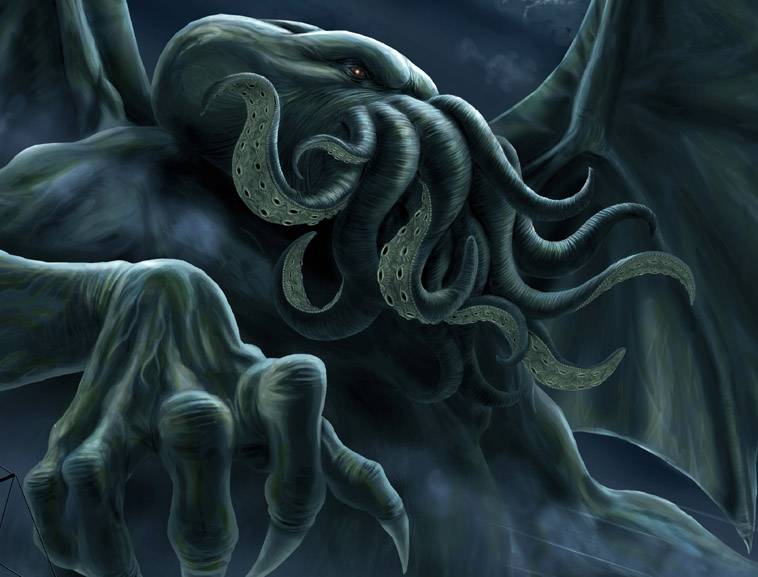
The Call of Cthulhu is broken down into three sections.  The first is written as a journal (as most of Lovecraft's works are) written by one Francis Wayland Thurston.  In seems that his great uncle recently died and has come to inherit the old man's papers and personal effects.  In looking through these items, Thurston finds a sculpture of a hideous monster surrounded by strange symbols.  It seems to have the body of a man, the head of an octopus (tentacles and all), and giant scaly wings and massive claws.  A bit of exploring hints at curious events leading to mass hysteria in certain parts of the globe - people having horrible dreams and deranged thoughts.

The second section is in the form of a journal entry of Thurston's uncle in which he meets a peculiar man who tells a tale of cults performing horrible rituals and giving praise to a creature called Cthulhu, whose description matches that of the sculpture.  They were overheard chanting the phrase "Ph'nglui mglw'nafh Cthulhu R'lyeh wgah'nagl fhtagn." (later translated to "In his house at R'lyeh dead Cthulhu waits dreaming".

In the last segment of the story, Thurston happens upon a transcript of a sailor's journal which describes a landing on a horrible slime covered island.  The monstrosity they discover there could spell the destruction of the would.

An interesting thing to note here is that Lovecraft utilizes a mechanic called plausible deniability.  That is to say that events occur in such a way that only a few people know of them.  In this case, Thurston is the only man alive that knows about the lurking presence of this evil Cthulhu creature.  By keeping the events in his stories a mystery to the outside world, Lovecraft increases the tension that the main character is feeling.  There is no sense of "Oh, Cthulhu, I read about him in the newspaper."  Each character is on his own as far as discovering the hidden truths of the universe.  Lonecraft does this with many of his stories.

Read the full version of The Call of Cthulhu here.