Showing posts with label Dracula Week. Show all posts

Saturday, August 28, 2010

Dracula Week Wrap-Up and Giveaway Winner

Hey everyone, happy Saturday!  Dracula Week has been a lot of fun for me, and I hope it's been fun for you too.

The first order of business is sending out a big THANK YOU to everyone that made this possible.
  • Thank you Heather, from the Maiden's Court, for helping develop this whole week!
  • Thank you to Karen Essex for giving us a great interview!
  • Thank you - ALL of you readers - who read, enjoyed, and joined in the discussions of the week.
Secondly, if you missed any Dracula Week events (or want to revisit them), feel free to use this handy directory
And finally, the moment you've all been waiting for...

The winner of the Dracula, by Bram Stoker, is...

ibeeeg!

Congratulations!  And thank you all for making this the best Dracula Week ever!

Friday, August 27, 2010

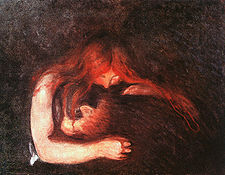
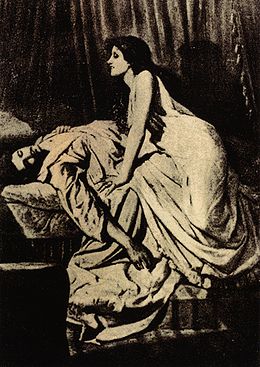
Origins of the Vampire

Greetings to you during this fine week of the Vampire.  I would like to wrap up the week with a brief discussion about the origin of the vampire:  where the myths originated, the beliefs that led to the legends, and the rise of the vampire in popular culture.  There is a ton of information out there, and this post will primarily serve as a summary and a starting point for your own research.  Feel free to check out the links at the bottom of the page for more information.  And without further delay, let us begin our journey...

Although the term "vampire" is a relatively new one, ancient cultures have all had their own way of describing evil entities who survived off of the life and essence of others.  These were classically monsters or demons that fed off of the blood of living people.  The ancient Persians described men who drank the blood of their fellows.  Gods and goddesses of religions were known to drink the blood of their worshipers; both Sekhmet of Egyptian lore and Kali of Indian legend are examples of this.  Even the Old Testament of the bible describes Adam's first wife, Lilith, as giving rise to demons who would drink the blood of men, women, and children.

The first manifestation of what we would now consider a vampire legend occurred in ancient Slavic culture.  Through a mix of pagan worship and the new influence of Christianity, these individuals strongly believed in the separation of the body and the soul, and that if a malignant soul was buried improperly, it would rise again and take the form of an animal or human to destroy its former loved ones.  The evil spirit, called a vampir would be so jealous of life and beauty that it would strip all things of these boons.

As these legends began to spread to Western Europe during the Medieval period, new stories of horror began to spring up.  In a grim preview of the ignorance that would fuel the witch trials of early America, hysteria swept throughout Europe and countless innocent citizens were murdered and maimed in the name of slaying possible vampires. 

The romanticism of the vampire myth began as a result of John Polidori and his short story, The Vampyre, in 1819.  In it, Lord Ruthven is a suave vampire who seduces and kills innocent women.  Vampires popped up in plays and serial publications for the next few decades until Bram Stoker published the quintessential vampire tale, Dracula, in 1897.  This novel has served as a jumping-off point for countless movies, novels, comic books, and television shows.

Despite this period of marketing the vampire, legends and paranoia still abound in some parts of the world.  In the early 2000's, accusations of vampires in Africa led to at least one man being stoned to death.  There have also been urban legends in England that a series of murders occurred in which the victims were bitten on the neck.  In 2004, a Romanian family dug up the corpse of a man and burned it under the assumption that he may become a vampire.  It is clear that the legend still lives on.

I hope you enjoyed this stroll throughout the history of the vampire.  For more information, feel free to follow these other leads:

Wikipedia
The Watcher's Zone
The Mythology of the Vampire

Head on over to The Maiden's Court for Heather's long-awaited review of Dracula in Love, by Karen Essex

And today is your last day to enter the giveaway for Dracula by Bram Stoker!  The winner will be announced tomorrow.

Thursday, August 26, 2010

Know Thy Enemy! Anatomy of a Vampire

Throughout history, many attributes and powers have been attributed to the vampire.  Today, we inspect the anatomy and physiology of a vampire, as put forth by Bram Stoker in Dracula.  One can only hope, dear reader, that this makes you prepared in the event that you face a member of the undead.

The Strengths of a Vampire...
  • Super human strength.  Stoker depicts Dracula has having the raw strength of twenty full grown men.  This enables him to fight proficiently and climb up walls.
  • Transformation.  Dracula is able to transform into different animals, many of which are so called "evil", such as rats, bats, and wolves.
  • In the mists.  Vampires are able to turn into mist and fog, and travel through very small cracks.
  •  Immortality.  The vampire does not die of old age, and cannot be killed with traditional weapons.
The Weaknesses of a Vampire...
  • Distaste for garlic.  The scent of garlic, especially the garlic flower, keeps a vampire at bay.  Wearing a garland of garlic flowers can keep an individual protected, and lining windows and doors can bar an entire room from the undead.
  • Unholy monsters.  Holy symbols, such as holy water and crucifixes, can stun a vampire and make it flee.  A blessed Eucharist can be used to seal doorways or be placed in the vampire's coffin to bar its entry.
  • Limited traveling.  Vampires can only cross running water when the tide changes.
  • Picky sleepers.  A Vampire often sleeps during the hours of daylight, and then only on the soil of their native land (often contained in a box or coffin).  Contrary to popular belief, Dracula is able to come out during the day.  This myth came about in the film, Nosferatu.
Other Traits...
  • Little to no vanity.  Upon looking into a mirror, vampires show no reflection.
  • Sneaky sneakers.  Vampires do not cast a shadow.
  • Polite, too.  Dracula is not able to enter a household unless an individual who resides there gives him express permission.
Disposal of a Vampire...
  • Heartless.  A stake must be driven through the vampire's heart.  Ash or oak is best.  The vampire must then be decapitated and garlic must be placed in its mouth.
I hope you enjoyed this examination of the vampire.  Now, check out The Maiden's Court for the second part of our interview with Karen Essex, author of Dracula in Love.

And remember to enter the giveaway for Dracula.  The giveaway ends tomorrow!

    Wednesday, August 25, 2010

    Author Interview - Karen Essex, author of Dracula in Love - Part 1

    Hello everyone, and welcome back to Dracula Week!  Today I am happy to share with you the first part of a two part interview with Karen Essex, the author of Dracula in Love.  I hope you enjoy!

    Lions and Men:  What was it about Bram Stoker’s Dracula that made you want to revisit the story from Mina’s perspective?

    Karen Essex:  From the first time I read Stoker’s Dracula in my teens, I just knew that Mina Harker, Dracula’s obsession, was not satisfied with her role as the quintessential Victorian virgin. I knew that there had to be more to her than that. (I knew that there had to be more to any woman than that.) Little did I dream that many years later, I would actually be a novelist and have the opportunity to revise the story, retelling it from Mina’s perspective.

    LM:  Were you always a Dracula fan?

    KE:  It began when I was a girl in grade school and saw Dark Shadows on TV. I remember racing home on my bicycle to see what blood-curdling adventures awaited the characters at the Collinwood Mansion. I’m from New Orleans, where we believe in the mystical, and the Anne Rice novels only fueled my fascination. I do a lot of screenwriting and have been influenced by vampire films as well, everything from Nosferatu to The Hunger to Coppola’s Dracula. I’ve always loved the glamorous vampires more (too much of the New York Dolls at an impressionable age, I guess), but have great empathy for the monsters.

    LM:  Was it difficult/scary to attempt to write this classic story from a new angle? How did you tackle this challenge? How did you determine what to stick closely to and what to change up?

    KE:  Yes, it was intimidating, and I knew that I would automatically alienate the purists. But what is life without risk? I believed that I had a lot of new elements to bring to the party such as a strong female perspective, a rich portrait of the era, and the lexicon of vampire mythology. At some point I realized that I had to “free” myself from Stoker’s text or I would be too beholden to its trajectory, so I introduced Stoker himself as a character. He runs into my characters and misinterprets what is going on with them. He goes on to write his own story, whereas Mina reveals the “truth.”

    I want to send a big thank you to Karen Essex for taking time to do this interview!

    You can catch the second part of this interview at The Maiden's Court tomorrow.  As for today, check out Heather's special "Caught on Tape" segment featuring Dracula films.

    And don't forget to enter the giveaway of Dracula, by Bram Stoker.  You only have three more days to enter!

    Tuesday, August 24, 2010

    Vlad the Impaler - the Man Behind the Myth

    Bram Stoker's depiction of the master vampire Dracula has become so iconic that the character has been replicated countless times.  Dracula has become the pinnacle of vampire lore, a mold to which all others are compared.  However, an even more interesting story is centered around the man whom Stoker took inspiration from in his horrific antagonist:  Vlad the Impaler.

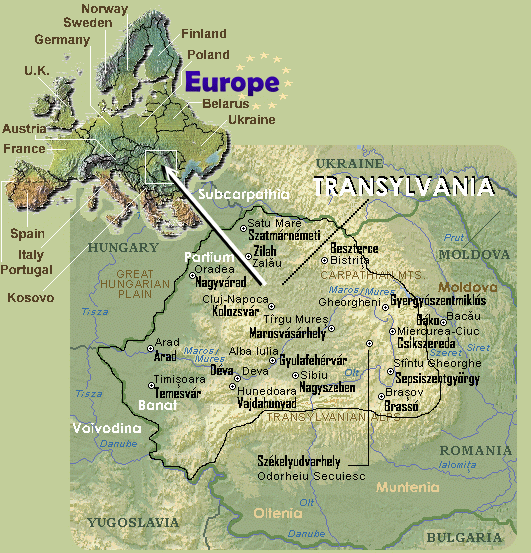
    Vlad III (the Impaler) was born in Transylvania (present day Romania) in 1431, and would be destined to be a ruler, an avenger, and a monster.  In seventeen short years, he would rise to become the ruler of Wallachia, an area within modern day Romania.  The wake of blood and death he left in his path would prove to be more than enough inspiration for Bram Stoker.

    Vlad's story actually begins with the story of his father, Vlad II.  Vlad II adopted the surname of Dracul, meaning dragon, when he was inducted into the Order of the Dragon.  This brotherhood of knights were sworn to protect the Holy Roman Empire and wage war against the Islamic Turks.  Surprisingly, Vlad Dracul betrayed the Empire and made a deal with the Turks - he would give up his two sons (one of which was Vlad III) to the Turkish Sultan in exchange for power and wealth as the ruler of Wallachia.

    Vlad Dracul's life was cut short, however, when his brother (still loyal to the Holy Roman Empire) assassinated the traitor and filled the court with his followers.  Vlad III, taking the name of Dracula, meaning "son of Dracul", was released and eventually rose his own group of rebels to overthrow his uncle.  Dracula forced his uncle's strongest followers into slavery and killed and tortured the rest.

    Although Dracula showed that he was skilled in various forms of torture and murder (burning alive, decapitation, etc), his favorite by far was impaling, in which a human body was impaled on a large vertical pole, the weight of the body slowly pulling it downwards.  The death was painful, and slow.  In this way, Vlad the Impaler struck fear into the hearts of his enemies and followers alike.

    Another example of Dracula's brutality:  When he decided that hunger and poverty held no place in his kingdom, Vlad gathered all of the poor and hungry from the streets and invited them to a large banquet.  When asked if they would like to never feel the pains of hunger again, the pauper's were obviously overjoyed - until Vlad ordered the banquet hall sealed off and burned to the ground.  No one survived.

    After many battles and shifting alliances, Dracula wandered down his father's footsteps one more time when his brother betrayed him.  Vlad's demise finally met up with him when he found himself in the middle of a battle that he could not win.  He was decapitated, and his head was impaled for all to see.

    Now that you have read about the origin of the character of Bram Stoker's Dracula, head over to The Maiden's Court to listen in on a conversation between Heather and I about the similarities and differences of Dracula and Dracula in Love.

    And also don't forget to enter the giveaway of Dracula.  It ends this Friday!

    Monday, August 23, 2010

    Book Review - Dracula, by Bram Stoker

    Title:  Dracula
    Author:  Bram Stoker
    Genre:  Horror
    Rating:  3.75 out of 5 fangs

    An ancient evil lurks in a decrepit castle in Transylvania.  The natives know well enough to give the mansion a wide berth, but the ignorance of a young Englishman, Jonathan Harker, threatens to spread a plague of living death throughout England.  Dracula has long been known as a classic of suspense and horror.  L&M finally gets a chance to sit down with Mr. Stoker's masterpiece.

    Dracula tells the tale of a group of people who live in and around London.  It begins when Jonathan Harker, a real estate lawyer, visits Count Dracula in Transylvania.  The Count recently purchased a mansion in England, and wishes to learn everything he can about the culture before he moves.  We quickly learn about the horrific reality of Dracula, and follow the main characters as they struggle to undo the evil that has been done to their loved ones.

    The novel is written in the form of a journal, or more accurately, in the form of the journals of many of the main characters.  I always loved the idea of telling a horror story in the first person, as the reader only knows what the characters know.  This method builds up a lot of suspense.  Almost all of the main characters have a journal, which gives a variety of viewpoints on the happenings of the book.  While this is a good way in which to tell the story, I imagine it is somewhat unrealistic.  Although people may have been more into writing journals in Victorian England, the amount of detail and exhibition included in the entries borders on ridiculous.  How does one write 30 pages about an event that lasted only a few minutes?

    The characters in Dracula, while interesting, tend to be somewhat two-dimensional.  Mina Harker is the beautifully intelligent young woman, Quincy Morris is the rough-riding American from Texas, Arthur Holmwood is the English gentleman.  But although we may have seen all of these archetypes before, the situations that Stoker puts them in are unique (to the period anyway), and this is where Dracula truly shines.

    The story of Dracula includes some very shocking and interesting scenes, including a recently deceased woman drinking the blood of children, three beautiful and deadly vampires, and an empty ship captained by a dead man.  This is what really keeps the reader forging through the novel.

    Although perhaps not fully realized, I believe Dracula deserves its place in history and literature.  The lore introduced and embellished in the novel has dramatically affected an entire genre of horror writers.  I ultimately enjoyed Dracula, and would recommend it to any hardcore horror enthusiast or those who enjoy classic literature.

    3.75 out of 5 fangs.

    Don't forget to enter the giveaway for this book, ending August 27th (this Friday!)

    Wednesday, August 18, 2010

    Giveaway: Bram Stoker's Dracula, and DRACULA WEEK Announcement


    Hi folks. It is my great pleasure to let you know that Dracula Week is coming to Lions and Men! This event is hosted by Lions and Men along with The Maiden's Court, and will run from 8/23 to 8/27. We thought it would be fun as I recently read Dracula by Bram Stoker and Heather recently read Dracula in Love by Karen Essex.  Make sure to check out Lions and Men and The Maiden's Court each day next week for reviews, interviews, and other interesting things relating to vampires and Dracula!

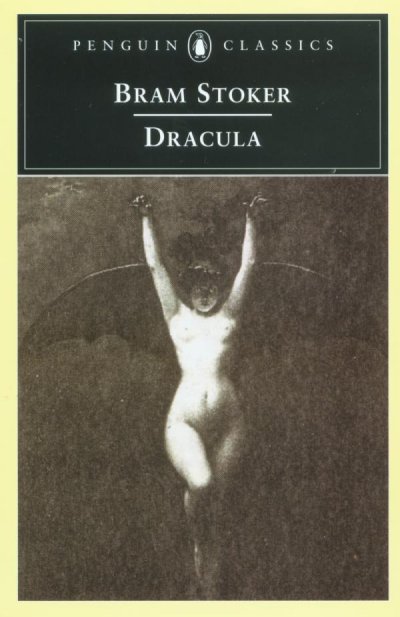
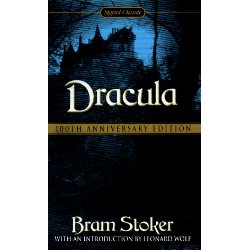
    And, in keeping with the theme of the coming week, I have a special giveaway for you - a 100th anniversary edition of  Dracula, by Bram Stoker!


    From the back of the cover:  "Count Dracula sleeps in a lordly tomb in the vaults beneath his desolate castle.  His stony eyes are open.  His cheeks have the flush of life beneath their pallor.  On his lips - a mocking, sensuous smile and scarlet-fresh blood.  He has been dead for centuries, yet he may never die...  Here begins the story of an evil ages old and forever new.  It is the story of those who feed a diabolic craving into the veins of their victims, into the men and women from whose blood they draw their only sustenance.  It is a novel of peculiar power, of hypnotic fascination.  The reader is warned that he who enters Castle Dracula may not escape its baleful spell, even when he closes this book."

    This giveaway will run from 8/18/10 to 8/27/10.  The winner will be announced on 8/28/10.  Please, United States entrants only.  The following is a list of how you can enter the giveaway and increase your chances of winning!

    +1 Entry - Comment on this post, including a contact e-mail address (required to enter the contest)

    +3 Entries - Become a follower of Lions and Men or The Maiden's Court, or let me know if you already follow (+3 for each blog followed)

    +1 Entry - Post a link to this giveaway, or mention Dracula Week (with a link to Lions and Men or The Maiden's Court) in a Tweet, blog post, or blog sidebar - feel free to borrow our button!  Make sure you post a link to whatever you do in your comment!

    +1 Entry - Leave a comment on any Lions and Men content posted in the week of 8/23-8/27 (+1 for EACH post commented on).

    Good luck to everyone, and I hope to see you next week!