Wednesday, August 17, 2011

Book Review Double Feature: The Anubis Gates and The Time Traveler's Wife

Today we will be taking a look at two other books about time travel.  I reviewed The Anubis Gates, written by Tim Powers, last year, and I am going to refeature it here because of its relevance.  Also, Heather over at The Maiden's Court has read and reviewed The Time Traveler's Wife by Audrey Niffenegger, which I will also share with you.  So, without further adieu...

--

Title:  The Anubis Gates
Author:  Tim Powers
Genre:  Science Fiction
Rating:  3.75 out of 5 body-snatching werewolves

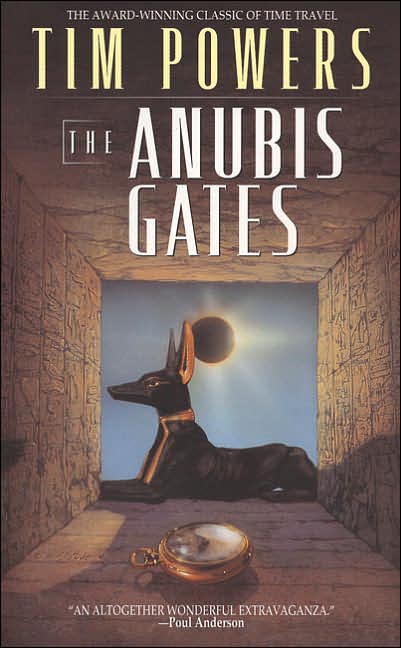
The cover of The Anubis Gates touts Powers' novel as a "classic of time travel".  Between this statement and the less-than-subtle inclusion of Egyptian themes, I became hooked and brought the book home.  Does it measure up to expectations?  Yes and no.

The Anubis Gates follows the life of Brendan Doyle as he meets up with an eccentric millionaire and travels back to 1810 to watch a speech made by author/poet Samuel Coleridge.  In so doing, Doyle gets involved with bands of murderous street beggars and ancient Egyptian sorcerers.

In short, The Anubis Gates is so packed to the brim with science fiction and fantasy elements that Powers is sometimes unable to juggle them all well.  My favorite thing about time travel stories is how the characters' muddling in the past affects their present.  And although this can be seen by the end of the book, I was less than impressed with the "time" element for most of it.  The main character time traveled, yes, but then the novel seemed to switch over to simple misadventures in 19th century London.  Instead of going heavy into time travel, Powers introduces theories such as Egyptian sorcery, cloning, and body-snatching werewolves.

Throughout all of these crazy plot points, the character of Brendan Doyle develops in a mostly predictable pattern (preoccupied academic learns that it is better to live life rather than study it) and the villains just don't feel evil enough.

In reading The Anubis Gates, I was certain that I was going to give it a rating of 3 or under.  However, in the end, I was pleased with how all of the seemingly disjointed SFF elements were brought together.  Some of the plot points were predictable, but that didn't make them any less fun to read about.  Ultimately, I couldn't decide on either a 3.5 or a 4 rating for this one, so I averaged them.

Is The Anubis Gates an epic knock-your-socks-off time travel adventure?  Not quite.  Although a fun read, there were too many ideas to sift through to make any one shine.  This one may or may not be worth the time, depending on what you are expecting.

3.75 out of 5 body-snatching werewolves.

--

The Time Traveler’s Wife by Audrey Niffenegger
Paperback, 546 pages
Houghton Mifflin Harcourt
May 27, 2004

“When Henry meets Clare, he is twenty-eight and she is twenty. Henry has never met Clare before; Clare has known Henry since she was six. Impossible but true, because Henry finds himself periodically displaced in time, pulled to moments of emotional gravity from his life, past and future. Henry and Clare's attempts to live normal lives are threatened by a force they can neither prevent nor control, making their passionate love story intensely moving and entirely unforgettable. The Time Traveler's Wife is a story of fate, hope and belief, and more than that, it's about the power of love to endure beyond the bounds of time.”

Henry DeTamble is just your thirtysomething average guy – he’s a librarian, is in a relationship, and likes to go out and have a few drinks – except he time travels at any given moment and leaves a pile of clothes behind, and when he comes back he is absolutely naked!

Clare Abshire is your average little girl – she has picnics in the meadow, goes to school, and lives in a huge house – except a naked older man shows up in the meadow one day and tells her he’s a time traveler!

The first time Clare meets Henry he is time traveling – 14 years later she meets him in his present time. A romance grows between them and Henry and Clare attempt to work out a life together dealing with his time traveling.

For me, this was my first book that really involved time travel. Henry couldn’t control his time traveling and never knowing when it was going to happen always made for interesting occasions. Also, showing up somewhere naked can really put a cramp in trying to go unnoticed - it can also end up being quite dangerous. One of the things that I enjoyed about this novel was that we get to see how time traveling effects those that Henry loves - the fear that comes with not knowing if he will come back ok. I think this is the first time I ever thought of time travel as something where you could get hurt and not return in the same condition in which you left. The time travel aspect was integrated into the folds of the story entirely - it never felt like it was just thrown in there for kicks.

With all of this time traveling, occasionally it was difficult to keep track of where in time he was and what he should or should not know at this time. As stated in the blurb above - Henry meets Clare when she is 6 and he is much older - so she has known him her whole life, but for Henry, time is not linear so he sometimes is very confused as to what he knows.

I was dreading the end of this book as it approached. I became so attached to Clare and Henry that I didn’t want it to end. I must warn you, this book is a tear jerker – at several points throughout the book. I absolutely loved this book. The characters are so real, true events are used, and the basic rules of time travel are addressed as well. The 600 pages just flew by! The book is also written in a humorous way – just wait for the part about Henry’s dreams, I couldn’t stop laughing.

This novel does have many romance elements but it isn’t the main focus and I would recommend this to anyone – men and women alike – everyone will find something to enjoy.

5 out of 5 stars


I hope you enjoyed reading about these two time travel novels!


Tuesday, August 16, 2011

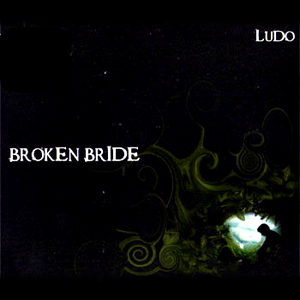
Time Travel in Music: Broken Bride, by Ludo

Time travel is a very popular topic of science fiction novels, but what about music?  Although a quick Google search yields a few quirky videos, I was able to find something much more epic for you all.

The little known rock band Ludo, which specializes in songs laced with heaping doses of geek humor, has released a five-song "mini album" about time travel.  In the rock opera, entitled Broken Bride, a nameless time traveler invents a machine and flies through time in order to save his deceased wife from a fatal accident.

Each song has a different feel to it, which reinforces the feeling of traveling through time.  From up-beat pop to more heavy rock and roll, Broken Bride spans multiple genres and generations.  I have embedded a player with the songs below.  The album is less than 30 minutes long, so if you love time travel, you should definitely give it a listen!  A quick summary of the songs will follow.


Part I:  Broken Bride.     A song sung to the Traveler's lost love.  In it, he describes how she died, and what he has done to try to save her.  It appears he has overshot his destination and crash landed in a world filled with dinosaurs, tar pits, and glaciers.  This song really has an epic feel, and its fast pace gives the listener a sense of urgency similar to what the Traveler must be feeling

Interlude:  Save Our City.     This time, we are treated to a glimpse into the future.  There is a conflict between the mayor of the City, the king he has aligned himself to, and a mysterious "tyrant god".  Zombies wander the streets and devour the helpless citizens.  One young boy travels to the mayor to plead for him to help.  The Traveler doesn't actually appear in this song.

Part II:  Tonight's The Night.     This peppy song returns us to the Traveler's plight, as he once again recounts the loss of his wife.  The up-beat lyrics and music of this song makes it clear that Part II actually takes place BEFORE Part I.  The optimistic Traveler lays out his plans to save his wife.  Little does he know the hardships he will face in trying to get back to her.

Part III:  The Lamb And The Dragon.  The Traveler has done it this time...  It seems he has flown to the future - one many years after the events of Save Our City.  It is clear now that the conflict has escalated, and the Apocalypse is almost upon humanity.  A band of rebellious humans has conspired to release a dragon, to fight the "tyrant god" who is now trying to destroy the world.  At the end of the song, the Traveler's machine is destroyed.  He speaks to what appear to be angels, and asks for a miracle to see his wife just once more...

Part IV:  Morning In May.  The Traveler wakes up in his bed, only to find his living, breathing wife laying next to him.  In this bitter sweet conclusion, the Traveler learns that he was never able to change the past, and that this morning in May really will be the last time he sees his love...

Monday, August 15, 2011

Book Review: The Map of Time, by Felix J. Palma

Title:  The Map of Time
Author:  Felix J. Palma
Genre:  Science Fiction
Rating:  2 out of 5 attempts to change the past

The Map of Time, by Felix J. Palma, is one of the more recent novels to be welcomed into the genre of time travel. I love anything that has to do with time travel, so I quickly picked this one up to read during the summer. The front cover says that it is “a brilliant and breathtaking trip”, unfortunately, this reviewer doesn’t believe that the Map lives up to the hype.

The Map of Time is broken up into three parts, each one telling a different time-travel-themed tale. These stories are interconnected, however. Characters and events from each affect the others in unforeseen ways. The first part recounts the journey of Andrew Harrington, who begins the tale in the throes of depression, and resorts to traveling through time to right the wrongs of his past. The second part deals with a love story between the well-to-do Clair Haggerty and the brave Captain Shackleton which breaks through the time-space-continuum and defies all laws of physics. The third relates the exploits of H.G. Wells (real-life author of The Time Machine) as he tackles the ramifications of traveling through time.

This format, though successful for other books, did not work for me. The events outlined in the exciting plot synopsis that is printed in the jacket (something we all consider when searching for great books, am I right?) are mysteriously nowhere to be seen for the first 500 pages of the book. I felt as though I was forced to wade through characters and plots that I didn’t really care about – just to reach something that I believe resembled the novel that I paid for. Unfortunately, by that point, the remainder of this “novel” was only fifty pages or so.

Along the way, the characters that we meet do little to hold our interest. They seem flat, bland, and all together devoid of life. They all seem to be whining or complaining about one thing or another, and they didn’t inspire anything resembling empathy in this reader’s skeptical heart.

Palma’s choice to set his novel in Victorian London also had me underwhelmed. 19th century England is such a lush and colorful setting, but the author neglects to use it to his advantage. For the most part, any of the plot points could have happened in any time period. For a novel that is supposed to be about time and time travel, one would have hoped that the actual time period would have played more of a role. Unfortunately, this is not the case.

All of this could have been forgiven, however, if the plot was solid and intriguing. When reading a novel about time travel, I want the story to be lush and multilayered, in which all possible repercussions of traveling through time are considered. Palma, however, gives only a passing glance at the intricacies of time travel, and seems to only focus on random aspects that suit his needs at the time. Truly, most of the plot points felt contrived and ultimately unnecessary. Characters often make extreme (and illogical) jumps of logic, only to move the story forward.  Palma's supposed plot twists, as opposed to being exciting, are merely disappointing, and change the novel from bad to worse.

With so many excellent science fiction and time travel novels out there, I find it hard to dig up much I liked about The Map of Time. Perhaps the only bright spot is the character of H.G. Wells. He has a part in each of the three stories, and is ultimately the protagonist of the whole mess. However, when added to the rest of the novel, his inclusion seems only to serve as a desperate grab at a bit of “science fiction notoriety”, which Palma seriously lacks.

2 out of 5 attempts to change the past.

Thursday, July 28, 2011

100 Followers and Summer Update!

Hi folks, I know that it has been an embarrassingly long time since my last update, but I just wanted to thank all of you for supporting Lions and Men during one of the busiest times of my life.  I am very humbled knowing that 100 people now are interested in what I can bring to the blog-o-sphere, sparse though it may be as of late.

My first year of vet school went very well, and I am taking the summer off to do some volunteer work and to get back into reading.  And, along those lines...

Look forward to a week devoted entirely to my sci-fi favorite, time travel, by the end of the summer.  It will feature reviews of works both old and new (The Time Machine by H.G. Wells and The Map of Time by Felix J. Palma, to be precise), as well as a bunch of other fun time travel stuff!

I look forward to talking to you all in.... THE FUTURE!

Wednesday, December 22, 2010

Book Review: The Way of Kings, by Brandon Sanderson

Title: The Way of Kings
Author: Brandon Sanderson
Genre: Fantasy
Rating: 4 out of 5 magical swords

The Way of Kings (or just Kings from now on) is the first novel in a planned ten book series written by Brandon Sanderson. A ton of hype surrounded this book before release, and many hoped (myself included) that it would be the beginning of “our” generation’s great fantasy series. How does it stack up against the monolithic authors that we have come to rate all others upon (I’m looking at you, Tolkien, Rowling, and Lewis)? Let’s find out...

Kings, at its heart, is a story of war. There is plenty of bloodshed on the battlefield, but conflict is also buried deep in the hearts of the main characters of the novel. The story follows the lives of three people as they struggle to survive in the desolated continent of Roshar.

They are...

Kaladin: A young man who was trained as a surgeon, and then became one of the best spearmen in Alethkar’s army. For unknown reasons, we now find him branded as a slave and a murderer sent to rot and die in a work camp for the same men that he protected. Memories of past failure and death haunt Kaladin, and he must overcome them if he is to escape the clutches of the tyrants who rule him.

Dalinar: A Highprince of Alethkar, uncle to the reigning king, and commander of a tenth of the nation’s troops. Rumors run wild through the camps that this once brutal war chief has lost the taste for battle, and has slowly been losing his mind. Dalinar walks a difficult line between the man others need him to be and the man who he promised himself he would become.

Shallan: A young woman who has traveled to a far-away kingdom in order to become a pupil of Jasnah, one of the wisest women in the world, and sister to the king. Shallan would do anything to achieve this goal; to fail would signal the fall of her entire family.

Kings focuses mainly on the nation of Alethkar, as it seeks vengeance on a seemingly endless number of foes for the murder of the previous king. The Highprinces, instead of uniting to crush the foe – squabble and compete with one another. Alethkar used to be a symbol of honor and pride, but it has quickly descended into chaos.

Sprinkled among the chapters are various “interludes” – short tales focusing on different characters and different regions of Roshar – meant both to break up the story and to give some hints at the broader plot of the series as a whole. Some of these are very exciting (especially those about the brutal assassin who can bend gravity to his will), but others seem only to slow down the pace of the novel. After all, it is likely that we will never hear from these “interlude” characters again, so it is hard to care about them or their situations.

The main characters, though much more solid, do not feel as three dimensional as Sanderson’s other creations. You can be sure that all three of the characters...

1. Are hiding a terrible secret from their colleagues
2. Are “rife” with a simple internal conflict
3. Change from one viewpoint to a second (opposite) viewpoint multiple times throughout the novel

Sound familiar? These elements are part of every character (ever), but Sanderson doesn’t seem to take that extra time to really add something MORE to the mix in order to make them shine. I still cared about the characters, but they weren’t as colorful as those from other Sanderson novels.

This may be in part to the vast amount of time that Sanderson spends building his world – and let me tell you, this is a monolithic undertaking. Sanderson’s love for the unique is stamped throughout Roshar. It seems he has thought of everything, including...

Class structure and sociology – Those who are born with light colored eyes are naturally born to rule and hold higher places in society than those with dark eyes.

Economics – Money is in the form of small glass spheres that hold a gem stone. The type and size of the stone marks different denominations.

Religion – The most popular religion of our characters is Vorinism, a teaching rife with past failure and political implications

Gender roles – Males focus on war and politics and are often illiterate. Females read, write, and create art. Therefore, in order to be powerful, men and women must work as a team to account for the others’ weaknesses. There are even masculine and feminine foods.

Technology – Mankind has invented a variety of contraptions called fabrials, which use the power of gemstones to do many functions, from heating a room to turning stone into food.

Mythology – Countless stories and myths including The Almighty, his ten Heralds, evil Voidbringers, and the once majestic Knights Radiant who turned their back on mankind in their hour of need.

Geography and biology – The land of Roshar is constantly assaulted by disastrous storms that can rip people apart in an instant. As such, life has adapted. People live in small stone houses on the leeward side of large rock formations, plants such as blades of grass are able to retract themselves into the ground at the first sign of a threat, and animals are covered with large chitinous plates to protect them.

Nothing has been left out of Sanerdon’s world, and it is very satisfying to read about all of the little pieces that other authors tend to ignore.

Of course, the icing on the cake (as always) is Sandersons use of magic. In this novel, magic tends to be left to the myths and legends of Roshar. In fact, what magic the people do use is in the form of relics that have survived, namely powerful Blades and Plate armor that grants their owners superhuman strength and agility. All of these magical objects seem to feed off of Stormlight, a mysterious luminescence that is infused into gemstones whenever a storm passes. Unlike in Sanderson’s other novels, magic in Kings is mysterious even to those who wield it, so there is never a perfectly clear explanation of its workings. Indeed, I imagine a large portion of the series will be devoted to uncovering the secrets behind the magic of the land.

Being the first novel in a ten book series, Kings is meant mainly to introduce the main characters and the world that they live in. The pace is often slow and with a few exciting exceptions, not much actually happens in the book. This is understandable for a first book in a large series, but it can feel a bit tedious when that book is about 1000 pages long. Having said that, Kings is still a fun and exciting read, one just needs to have a good amount of “reading stamina” to get through it in one piece.  Those that do finish it will be rewarded:  the last few chapters in particular are like a punch in the stomach, and make you wish the novel was twice as long.

In all, The Way of Kings is a great start to what looks to be a lasting series.  Due to the unique and detailed world that Sanderson paints, Kings comes highly recommended.

4 out of 5 magical swords!


Wednesday, December 15, 2010

Behind the Scenes of HBO's Game of Thrones

Good day to you all!  I am very excited this evening because it means that HBO's new series based on George R. R. Martin's The Game of Thrones is one more day closer!  HBO has been showing the trailer more frequently, and they recently aired a short "Behind the Scenes" featurette about the first season.  Exciting!  Check it out!


Monday, December 13, 2010

Picture the Dead Giveaway Results

First, as always, I would like to send out a big thank you to everyone who entered this giveaway.

And the winner of a signed copy of Picture the Dead, by Adele Griffin ans Lisa Brown, is...

sharon54220!

Congratulations!